

Show Working

AlgebraFoundation and Higher

Factorising: GCSE maths practice with worked answers

Show Working has 2 kinds of factorising question for GCSE Maths, for Foundation and Higher. Every question is new each time and comes with the working, step by step.

Factorising is expanding in reverse: putting an expression back into brackets. You take out a common factor, or for a quadratic like x² − 9x + 8, find two numbers that multiply to the last term and add to the middle one.

Coming soon to the App Store

Worked example 1: factorise: take out a common factor

Factorise 4x − 8.

  1. Find the biggest factor that goes into every term (a number). Here it is 4.
  2. Write 4 outside a bracket. Inside, put what is left after dividing each term by 4: 4x ÷ 4 = x and −8 ÷ 4 = −2.
  3. So 4x − 8 = 4(x − 2).
  4. Check by expanding: 4(x − 2) gives back 4x − 8.

Answer 4(x − 2)
01 / What's covered2 kinds of question

Factorising questions in the app

Each kind makes fresh questions every time, so you can practise as often as you like.

  • Factorise: take out a common factorBoth tiers
  • Factorise a quadraticBoth tiers

Worked example 2: factorise a quadratic

Factorise x2 − 9x + 8.

  1. You need two numbers that multiply to 8 and add to −9.
  2. Try pairs: −8 × −1 = 8 and −8 + −1 = −9. That works.
  3. Put each number in a bracket with x: (x − 8)(x − 1).
  4. Check by expanding: it gives back x2 − 9x + 8.

Answer (x − 8)(x − 1)

A common mistake

Not taking out the highest common factor. 4x − 8 factorised fully is 4(x − 2), not 2(2x − 4).

02 / Practise itiPhone and iPad

Practise factorising in Show Working

In the app, open Topics and choose Factorising for ten fresh questions. Ask for a hint if you are stuck, and open the working to see the method one step at a time.

Coming soon to the App Store

More algebra topics

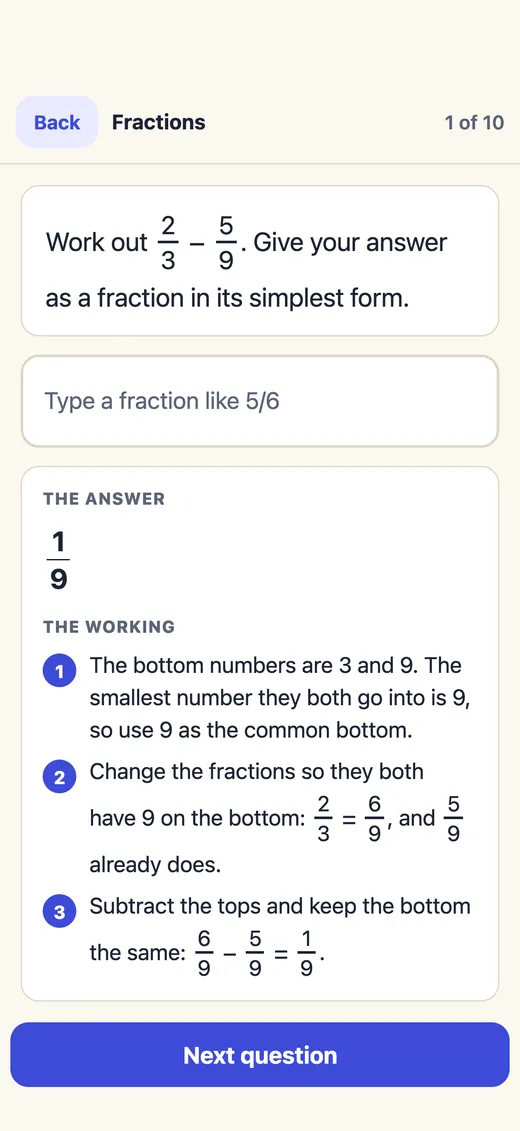
The worked answer in Show Working: the answer, then numbered steps in plain words

Show WorkingComing soon to the App Store