 Show Working
Nail the core topics
Fractions, percentages, ratio, rounding, area and angles, plus simple algebra like substitution and solving equations. They're the building blocks for loads of questions.
Revision guideGrade 4 and 5
In England a grade 4 is a standard pass and a grade 5 is a strong pass. If maths isn't your favourite subject, here's the good news: a 4 doesn't need every topic. It needs the common ones done reliably, and far fewer marks thrown away.

 Coming soon to the App Store
01 / What a pass meansEngland
02 / Where the marks areBank them, every time
Fractions, percentages, ratio, rounding, area and angles, plus simple algebra like substitution and solving equations. They're the building blocks for loads of questions.
Papers usually start with the more approachable questions. Don't rush them. Check each one before you move on.
Examiners give marks for a correct method, even when the final answer slips. A bare wrong answer gets nothing.
One of the three papers (for AQA, Pearson Edexcel and OCR) is non-calculator. Written methods for fractions and percentages pay off here.
Exams in 2026 and 2027 come with one. Know what's on it before the day, so you're not hunting for it mid-question. Formulas guide.
A blank space scores zero. Write down what you know, even the first step. It can be worth a mark.
03 / A four week planIf time is short
Twenty to thirty minutes on most days. More if you can, but steady beats heroic.
Go through the topics checklist. Start daily practice on number: fractions, percentages, ratio and rounding.
Substitution, simplifying, solving equations and sequences. Then area, perimeter and angles.
Mixed questions from every topic, and your first timed paper. Write down every topic you dropped marks on.
One or two timed papers. Fix the topics they show up, check your formulae sheet, and rest the night before.
04 / On Higher?Aiming for a 4 or 5
If you're on Higher and aiming for a 4 or 5, most of your marks will come from the first part of each paper. Make those questions bulletproof before you spend time on the hardest topics.
Higher has a safety net grade 3 for pupils who just miss a 4. Below that the result is a U. If you're worried about your tier, talk to your maths teacher early. More in Foundation or Higher.
05 / Practise itTen minutes a day
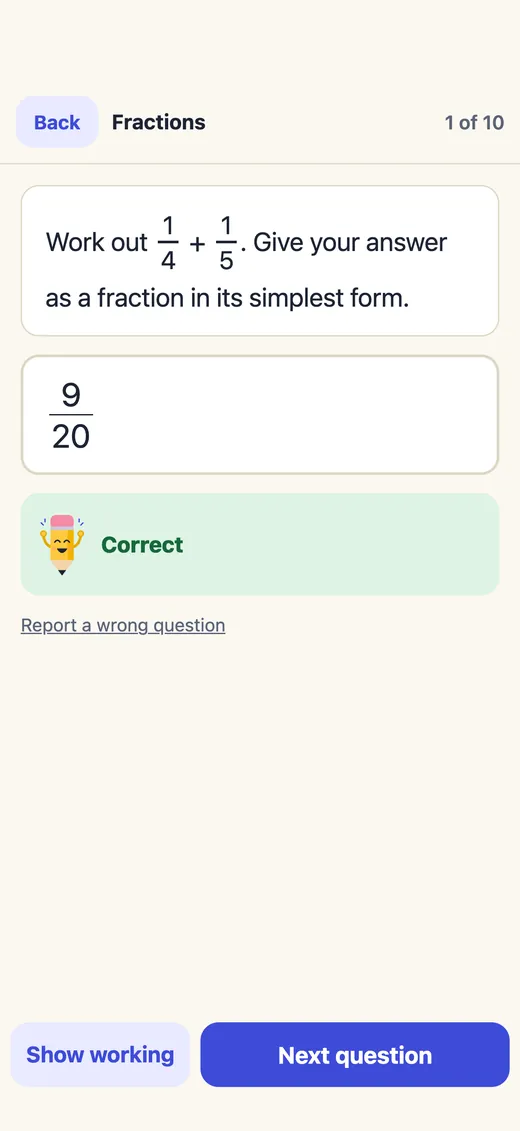
Show Working gives you fresh questions on every core topic, marked straight away, with the working shown when you get one wrong. Foundation or Higher, and you can switch any time.
Coming soon to the App Store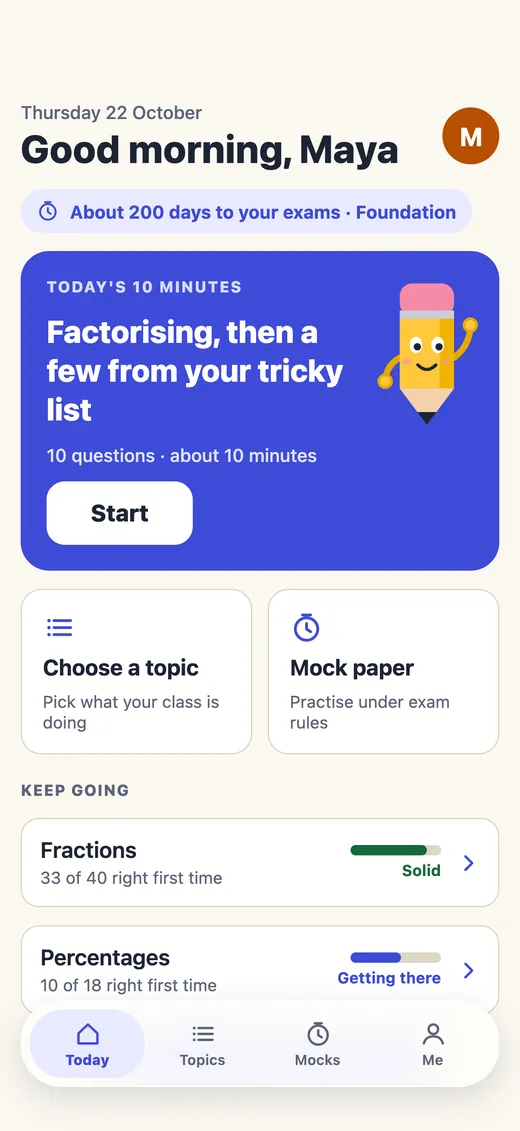
06 / QuestionsAll questions
Practise the written methods: multiplying and dividing on paper, fractions, percentages without a calculator, and rounding to estimate. Do some of your daily practice with the calculator out of reach.
A grade 4 is a standard pass and a grade 5 is a strong pass. Most colleges, sixth forms and employers ask for at least a 4, though some courses want a 5 or more.
In England, if you don’t have a grade 4 by 16, you’ll usually keep studying maths at college or sixth form alongside your main course. With a grade 3 that normally means taking the GCSE again. With a lower grade it can be a Functional Skills qualification first. Your college will tell you which.
Yes. Foundation papers go up to grade 5, and a grade 4 on Foundation is exactly the same grade as a grade 4 on Higher.
It changes every year, because grade boundaries are set after the papers are marked. Your exam board publishes them on results day, so don’t trust a fixed number you see online.
One topic at a time.
Fresh questions, marked straight away, with the working shown. The first topic is free.
Coming soon to the App StoreShow WorkingComing soon to the App Store