 Show Working
Monday to Thursday
15 to 20 minutes of mixed questions on your shaky topics. Check every wrong answer against the working.
Revision guideFoundation and Higher
Reading notes and watching videos feels like revision. But maths only sticks when you do questions, get some wrong, and work out exactly why. Here's a plan that works whether you have a year or a few weeks.
You can't revise maths by looking at it. You revise it by doing it.

 Coming soon to the App Store
01 / The short versionIf you read nothing else
02 / Step by stepFrom first day to exam day
Ask your teacher whether you're entered for Foundation or Higher, and which exam board you're with. The maths is the same for every board, but the tier changes which questions you'll see. Not sure which tier suits you? Read Foundation or Higher.
Go through a topics checklist and mark each one solid, shaky or not yet. Be honest: a topic you can only do with your notes open isn't solid yet.
Short sessions spread across the week help maths stick far better than one long cram. Ten to twenty minutes a day is a good start, and you can build up as the exams get closer.
Try a question before you look anything up. Getting it wrong isn't wasted time. It shows you exactly what to fix.
Don't just read the right answer. Cover the working, try again, then compare your method with the correct one line by line. That's where the learning happens.
Once a topic is going well, practise it mixed in with others. The exam won't tell you which topic a question is from, so you need to spot the method yourself.
In the last couple of months, do a timed paper every week or two: no notes, and no calculator on the non-calculator paper. Mark it honestly and fix what went wrong. Where to find past papers.
You get a formulae sheet in 2026 and 2027, but you still need to know which formula a question needs. See GCSE maths formulas.
Light practice the day before, then sleep. A tired brain makes silly slips on questions you can actually do.
03 / A normal weekAdjust it to your timetable
This is a starting point, not a rule. Fit it around school, work and everything else.
15 to 20 minutes of mixed questions on your shaky topics. Check every wrong answer against the working.
One topic in more depth: the one that keeps tripping you up. Try a few harder questions on it.
A timed mock or past paper every other week, nearer the exams. The rest of the time, take a proper break.
04 / Short on time?A few weeks to go
05 / How Show Working helpsiPhone and iPad
Coming soon to the App Store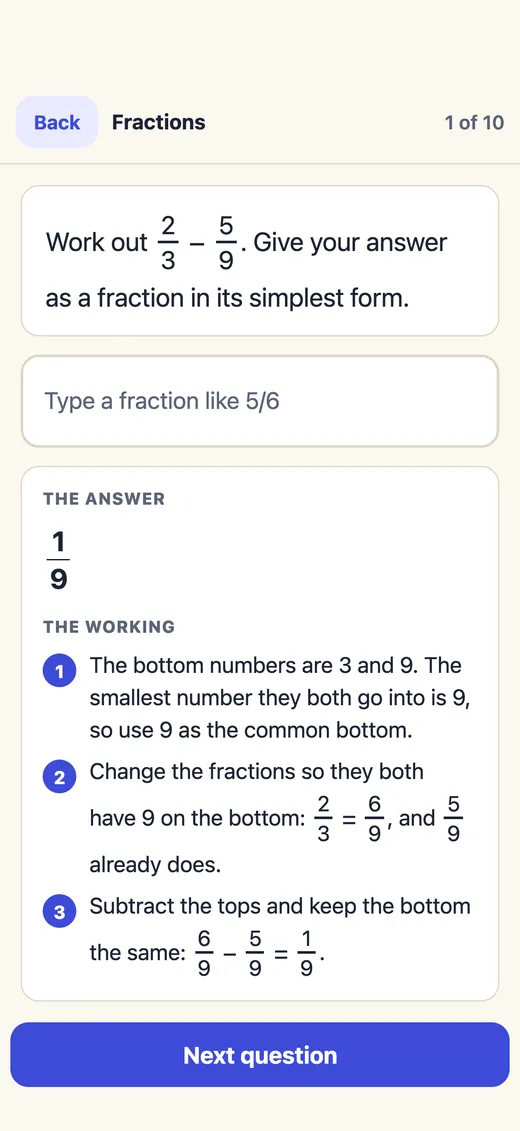
06 / QuestionsAll questions
There’s no magic number. For most pupils, 20 to 30 minutes of maths on most days works better than one long session a week, and you can do more as the exams get closer. What counts is doing questions, not the time spent.
Both, in that order. Revise by topic first to fix your gaps, then move on to mixed questions and past papers, so you get used to spotting which method a question needs.
Practise the written methods: multiplying and dividing on paper, fractions, percentages without a calculator, and rounding to estimate. Do some of your daily practice with the calculator out of reach.
The earlier the better, but a little and often from the start of Year 11 is plenty for most pupils. If your exams are only weeks away, start with the topics you nearly have right.
Little and often.
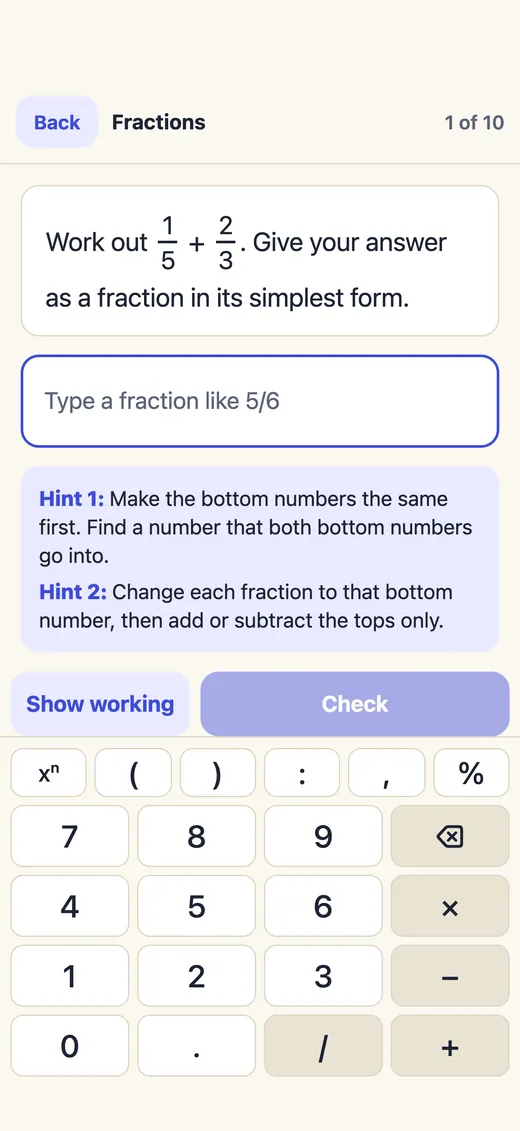
Fresh GCSE maths questions, with the working shown for every answer. The first topic is free.
Coming soon to the App StoreShow WorkingComing soon to the App Store