 Show Working
Revision guideChecklist
GCSE maths topics list: a checklist for Foundation and Higher
Every exam board in England teaches the same GCSE maths content, set by the Department for Education. Here it is as a plain checklist in six areas, with the Higher-only parts marked.
Go through it and mark each line solid, shaky or not yet. The shaky ones are where your revision should start.

 Coming soon to the App Store
01 / The checklistLinks go to worked examples
This is our summary in plain words, not the official wording. Topics with a link are in the Show Working app now, with worked examples on this site. For the exact list, check your exam board's specification or ask your teacher.
Number
- Place value, ordering and negative numbersBoth tiers
- Written methods for the four operationsBoth tiers
- Order of operations (BIDMAS)Both tiers
- Factors, multiples, primes, HCF and LCMBoth tiers
- Powers, roots and the laws of indicesBoth tiers
- Fractional indicesHigher only
- Fractions, including mixed numbersBoth tiers
- Fractions, decimals and percentages, converting between themBoth tiers
- Recurring decimals to fractionsHigher only
- Standard formBoth tiers
- Rounding, decimal places, significant figures, estimatingBoth tiers
- Error intervalsBoth tiers
- Calculating with upper and lower boundsHigher only
- SurdsHigher only
Algebra
- Algebraic notation and simplifying expressionsBoth tiers
- Substituting into expressions and formulaeBoth tiers
- Expanding bracketsBoth tiers
- Factorising, including simple quadraticsBoth tiers
- Factorising harder quadratics, like 2x² + 7x + 3Higher only
- Rearranging formulae (changing the subject)Both tiers
- Solving linear equationsBoth tiers
- Inequalities on a number lineBoth tiers
- Simultaneous linear equationsBoth tiers
- Simultaneous equations with one quadraticHigher only
- Solving quadratics by factorisingBoth tiers
- The quadratic formula and completing the squareHigher only
- Sequences and the nth termBoth tiers
- The nth term of quadratic sequencesHigher only
- Straight-line graphs and y = mx + cBoth tiers
- Quadratic, cubic and reciprocal graphsBoth tiers
- Exponential and trigonometric graphsHigher only
- Functions, inverse and compositeHigher only
- IterationHigher only
- Algebraic proofHigher only
- Equation of a circleHigher only
Ratio, proportion and rates of change
- Ratio: simplifying and sharingBoth tiers
- Percentages: increase, decrease and percentage changeBoth tiers
- Compound interest, growth and decayBoth tiers
- Direct and inverse proportionBoth tiers
- Proportion equations, like y = kx²Higher only
- Speed, density and pressureBoth tiers
- Scale drawings, maps and best buysBoth tiers
- Converting unitsBoth tiers
- Gradients and areas under graphs as ratesHigher only
Geometry and measures
- Angles: on lines, at points, in parallel lines and polygonsBoth tiers
- Properties of triangles, quadrilaterals and polygonsBoth tiers
- Perimeter and area, including circlesBoth tiers
- Arcs and sectorsBoth tiers
- Volume and surface area of prisms, cylinders, cones, spheres and pyramidsBoth tiers
- Pythagoras' theoremBoth tiers
- Right-angled trigonometry (SOHCAHTOA)Both tiers
- Sine rule, cosine rule and ½ab sin CHigher only
- Transformations: reflection, rotation, translation, enlargementBoth tiers
- Enlargement with a negative scale factorHigher only
- Congruence and similarityBoth tiers
- Area and volume of similar shapesHigher only
- Constructions, loci and bearingsBoth tiers
- Plans and elevationsBoth tiers
- Circle theoremsHigher only
- VectorsBoth tiers
- Vector proofsHigher only
Probability
- The probability scale and single eventsBoth tiers
- Relative frequency and expected outcomesBoth tiers
- Sample spaces, two-way tables and Venn diagramsBoth tiers
- Tree diagrams and independent eventsBoth tiers
- Conditional probabilityHigher only
Statistics
- Sampling and biasBoth tiers
- Bar charts, pie charts, pictograms and line graphsBoth tiers
- Mean, median, mode and range, including from tablesBoth tiers
- Scatter graphs and correlationBoth tiers
- Time seriesBoth tiers
- Cumulative frequency, box plots and quartilesHigher only
- Histograms with unequal class widthsHigher only
02 / Using the listTurn it into a plan
From checklist to revision plan
Mark every line honestly
Solid means you can do it without notes, today. Shaky means sometimes. Not yet means you'd need to look it up.
Start with the shaky ones
They're the quickest wins. Then work through the not-yets, starting with the ones on both tiers.
Come back every couple of weeks
Re-mark the list. Watching lines move from shaky to solid is the best motivation there is. More in How to revise for GCSE maths.
03 / QuestionsAll questions
GCSE maths topics, answered
Can I use past papers from other exam boards?
Yes. The maths content is the same for every board, so other boards’ papers are good practice. The layout and the number of marks are a little different.
Are the topics the same for every exam board?
Yes. AQA, Pearson Edexcel, OCR and WJEC Eduqas all teach the content set by the Department for Education. The papers look a bit different from board to board, but the maths is the same.
Which GCSE maths topics are Higher only?
Things like surds, circle theorems, the quadratic formula, the sine and cosine rules, functions, histograms and conditional probability. They’re marked Higher only in our topics checklist.
Shaky to solid.
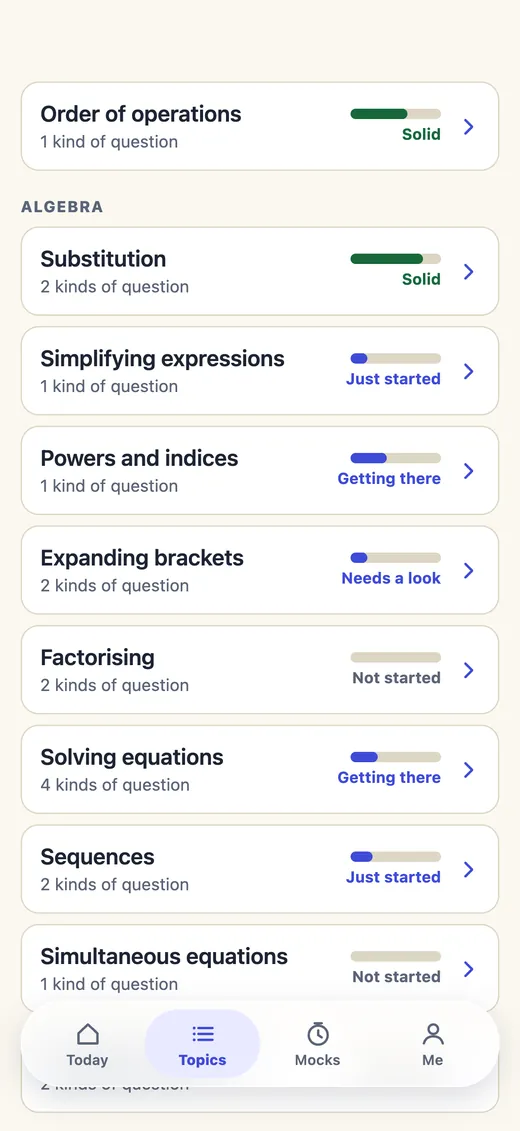
Show Working tracks every topic for you.
Each topic shows how solid it is, from Not started to Solid, as you practise. The first topic is free.
Coming soon to the App Store