

Show Working

ProbabilityFoundation and Higher

Probability GCSE questions with answers

8 probability questions to try, each with the answer and the full working one tap away. Every question here was made and worked out by the Show Working maths engine, not typed in by hand.

Probability questions cover single events, the chance that something does not happen, missing values in a table, expected results and relative frequency. You also find probabilities for two events, including two picks without replacement and two dice.

Quiz yourself: 8 questions

Worked example 1: probability of one event

A bag has 3 yellow and 6 green beads. One is taken at random. Work out the probability that it is green.

  1. There are 3 + 6 = 9 beads altogether.
  2. 6 of them are green.
  3. Probability = 6 out of 9 = 69, which simplifies to 23.

Answer 23
01 / Quiz yourselfTry it, then tap to check

Probability questions to try

Work each one out on paper first. Then open the answer and compare your working with ours, step by step.

01 / Probability of one eventBoth tiers

A bag has 8 white and 3 red counters. One is taken at random. Work out the probability that it is red.

Show the answer and working
  1. There are 8 + 3 = 11 counters altogether.
  2. 3 of them are red.
  3. Probability = 3 out of 11 = 311.

Answer 311

02 / The probability something does not happenBoth tiers

The probability that it will rain tomorrow is 35. Work out the probability that it will not rain tomorrow.

Show the answer and working
  1. Something either happens or it does not, so the two probabilities add up to 1.
  2. 1 − 35 = 25.

Answer 25

03 / Missing probabilities in a tableBoth tiers

A biased spinner can land on 1, 2, 3 or 4. The table shows the probability of each number. Work out the probability that it lands on 4.

12340.190.270.36x
Show the answer and working
  1. All the probabilities add up to 1. The ones you know add up to 0.19 + 0.27 + 0.36 = 0.82.
  2. 1 − 0.82 = 0.18.

Answer 0.18

04 / Expected resultsBoth tiers

The probability that a player scores from a penalty is 0.7. The player takes 40 penalties. How many goals would you expect?

Show the answer and working
  1. Expected number = probability × number of tries.
  2. 0.7 × 40 = 28.

Answer 28

05 / Relative frequencyBoth tiers

A dice is rolled 100 times. The table shows the results. Work out the relative frequency of getting a 3.

Score123456Frequency8302024135
Show the answer and working
  1. Relative frequency = number of times it happened ÷ number of tries.
  2. 20 ÷ 100 = 20100 = 15.

Answer 15

06 / Two events: and, orBoth tiers

Two spinners are spun. The spinners are independent. The probability the first lands on red is 0.25. The probability the second lands on blue is 0.8. Work out the probability that the first lands on red and the second lands on blue.

Show the answer and working
  1. The two events do not affect each other, so multiply the probabilities for "and".
  2. P(red on the first) = 0.25, P(blue on the second) = 0.8.
  3. 0.25 × 0.8 = 0.2.

Answer 0.2

07 / Two dice: sample spaceBoth tiers

Two fair dice are rolled and the scores are added. The table shows every possible total. Work out the probability that the total is 10.

+123456123456723456783456789456789105678910116789101112
Show the answer and working
  1. There are 6 × 6 = 36 equally likely results.
  2. Count the totals in the table that fit: 3.
  3. Probability = 336 = 112.

Answer 112

08 / Two picks without replacementBoth tiers

A bag has 5 black and 4 green counters. Two counters are taken at random, one after the other, without replacement (the first one is not put back). Work out the probability that both are the same colour.

Show the answer and working
  1. Both black: 59 × 48 = 2072.
  2. Both green: 49 × 38 = 1272.
  3. Either way: add them, 3272 = 49.

Answer 49

02 / What's covered8 kinds of question

Probability at GCSE and where marks go

  • Probability of one eventBoth tiers
  • The probability something does not happenBoth tiers
  • Missing probabilities in a tableBoth tiers
  • Expected resultsBoth tiers
  • Relative frequencyBoth tiers
  • Two events: and, orBoth tiers
  • Two dice: sample spaceBoth tiers
  • Two picks without replacementBoth tiers

Worked example 2: two picks without replacement

A bag has 4 blue and 7 green counters. Two counters are taken at random, one after the other, without replacement (the first one is not put back). Work out the probability that both are the same colour.

  1. Both blue: 411 × 310 = 12110.
  2. Both green: 711 × 610 = 42110.
  3. Either way: add them, 54110 = 2755.

Answer 2755

A common mistake

Keeping the same fraction for the second pick without replacement. From a bag of 3 red and 2 blue counters, P(two red) = 3/5 × 2/4 = 6/20 = 3/10, because one red has gone before the second pick.

03 / Practise itiPhone and iPad

More probability questions in Show Working

In the app, Probability makes fresh questions every time, so they never run out. Tap Show me one to see a new worked example straight away, or practise ten and open the working whenever you are stuck. Forgotten a method? Type it into Look up and the answer is there.

Coming soon to the App Store

More probability topics

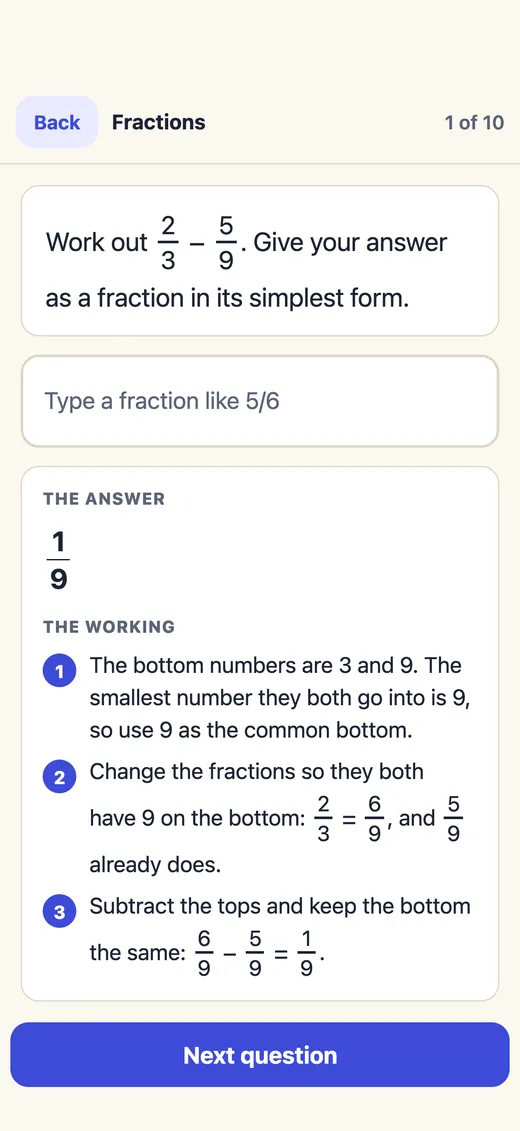
The worked answer in Show Working: the answer, then numbered steps in plain words

Show WorkingComing soon to the App Store