

Show Working

Revision guideExam technique

What does "show your working" actually mean?

It means writing down how you got your answer, not just the answer. In GCSE maths a lot of the marks are for the method, so a pupil who writes the steps can score well even when the final number comes out wrong.

It's also the name of our app, because it's the one habit that changes maths marks the most.

Coming soon to the App Store
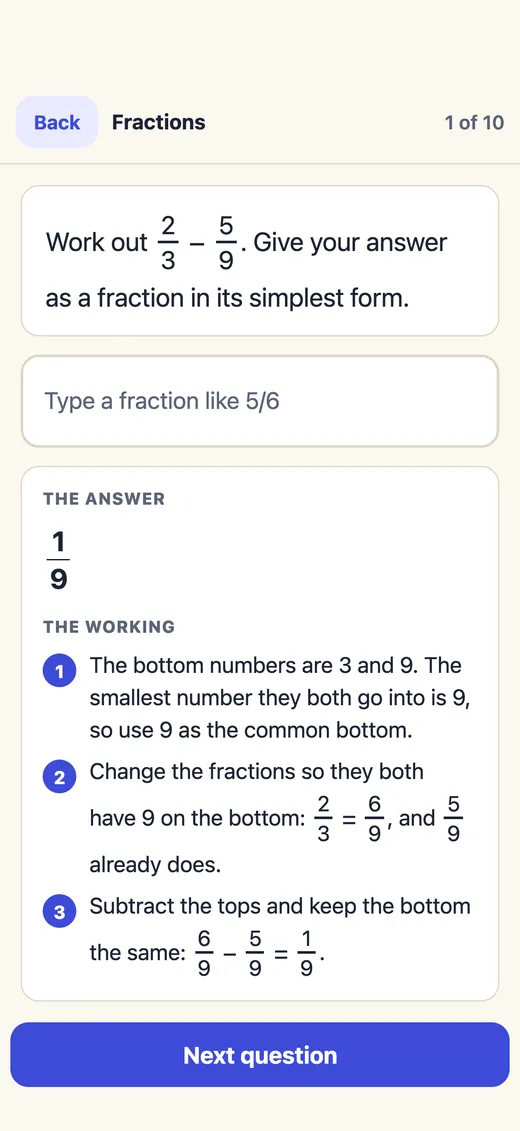
The worked answer in Show Working: the answer, then numbered steps in plain words

01 / Why it mattersWhere marks come from

Most marks are for the method

  • Questions worth more than one mark usually give marks for the right method along the way, then a mark for the answer.
  • A wrong answer with no working scores nothing, because the examiner can't see what you did right.
  • A slip in the last line, with clear working above it, can still earn most of the marks.
  • Some questions insist on it: "show your working", "show that" and "you must show your working" mean an answer on its own may get no marks at all.

02 / What good working looks likeA worked example

One step a line, every number explained

Here's a reverse percentages question, a Higher favourite, worked the way an examiner likes to see it.

In a sale, the price of a laptop is reduced by 25%. The sale price is £150. Work out the original price.

  1. The original price is 100%. After a 25% reduction, the price is 100% − 25% = 75% of the original.
  2. So 75% = £150.
  3. Divide by 75 to find 1%: £150 ÷ 75 = £2.
  4. Multiply by 100 to find 100%: £2 × 100 = £200.

Answer £200
The usual mistake

Taking 25% off £150 and getting £112.50, or adding 25% of £150 to get £187.50. The £150 is already 75% of the price, so you work back from 75%, not from 100%.

03 / Habits that earn marksDo these every time

  1. Write the calculation, not just the result

    "150 ÷ 75 = 2" earns a mark. "2" on its own can't.

  2. Say what each number is

    A word or two, like "1% = £2", shows the examiner your method even if the arithmetic goes wrong later.

  3. Keep the full calculator value

    Round only at the end, and write the unrounded value before the rounded one.

  4. Don't rub out

    Cross out with one neat line instead. Crossed-out work you didn't replace can still be marked.

  5. Put the answer where it's asked for

    On the answer line, with units, rounded as the question says.

04 / Practise itEvery answer, every step

See the working for every question

In Show Working every answer comes with its working, one step at a time, so you learn the method and not just the answer. Try it now with free GCSE maths questions with answers, or pick a topic from the GCSE maths topics.

Coming soon to the App Store
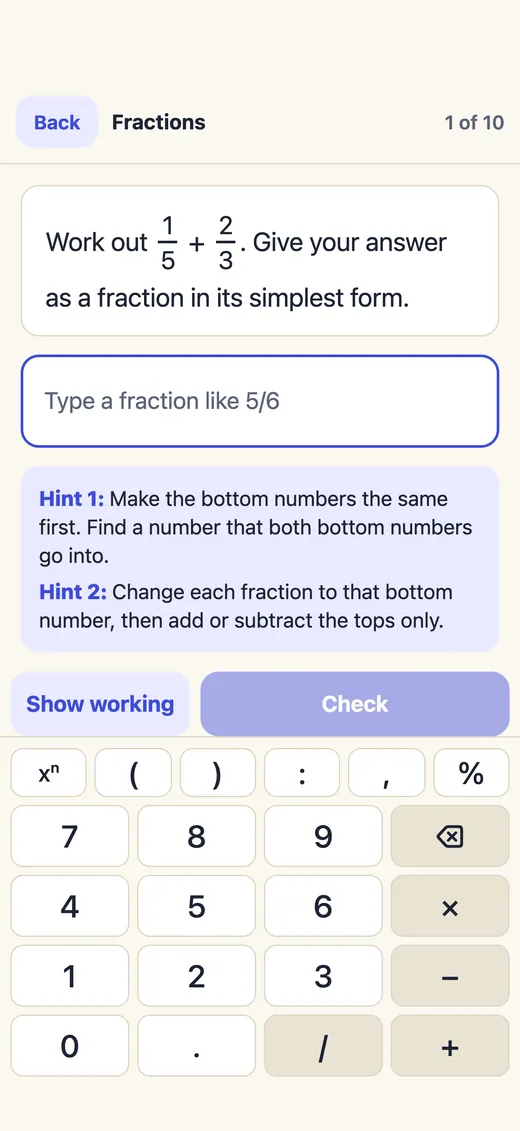
A fractions question in Show Working with two hints open

05 / QuestionsAll questions

Showing working, answered

Do you lose marks for not showing your working?

Often, yes. On questions worth more than one mark, most of the marks are usually for the method. With no working, a wrong answer scores nothing, and on questions that say "show your working" even a right answer on its own can lose marks.

Can you get marks for a wrong answer in GCSE maths?

Yes. If your working shows a correct method, you can earn method marks even when the final answer is wrong. That is why it pays to write every step.

More revision guides

Show WorkingComing soon to the App Store