Show Working

StatisticsFoundation and Higher (some Higher only)

Averages and range GCSE questions with answers

8 averages and range questions to try, each with the answer and the full working one tap away. Every question here was made and worked out by the Show Working maths engine, not typed in by hand.

Averages questions ask for the mean, median, mode and range, a missing value from a mean, and averages from a frequency table. You also estimate the mean of grouped data and find the modal class and the class with the median, and on Higher the quartiles and interquartile range.

Quiz yourself: 8 questions

Worked example 1: mean, median, mode and range

Here are the numbers of goals a team scored in its last 5 matches:
4,\ 2,\ 5,\ 4,\ 6
Work out the mean.

  1. Add them all up: 4 + 2 + 5 + 4 + 6 = 21.
  2. There are 5 numbers, so divide by 5: 21 ÷ 5 = 4.2.

Answer 4.2

01 / Quiz yourselfTry it, then tap to check

Averages and range questions to try

Work each one out on paper first. Then open the answer and compare your working with ours, step by step.

01 / Mean, median, mode and rangeBoth tiers

Here are the numbers of minutes 5 buses were late:
18,\ 12,\ 23,\ 16,\ 15
Work out the mean.

Show the answer and working
  1. Add them all up: 18 + 12 + 23 + 16 + 15 = 84.
  2. There are 5 numbers, so divide by 5: 84 ÷ 5 = 16.8.

Answer 16.8

02 / Mean, median, mode and rangeBoth tiers

Here are the heights, in cm, of 9 plants:
17,\ 40,\ 36,\ 26,\ 9,\ 29,\ 23,\ 14,\ 20
Work out the median.

Show the answer and working
  1. Put them in order: 9, 14, 17, 20, 23, 26, 29, 36, 40.
  2. There are 9 numbers, so the middle one is number 5: 23.

Answer 23

03 / Modal class and the class with the medianBoth tiers

The table shows the masses of some parcels. Which class is the modal class? Type its letter.

ABCDMass (m kg)0 < m ≤ 55 < m ≤ 1010 < m ≤ 1515 < m ≤ 20Frequency712179
Show the answer and working
  1. The modal class is the class with the highest frequency.
  2. The highest frequency is 17, for 10 < m ≤ 15.
  3. So the answer is C.

Answer C

04 / Modal class and the class with the medianBoth tiers

The table shows the heights of some Year 11 pupils. Which class contains the median? Type its letter.

ABCDHeight (h cm)140 < h ≤ 150150 < h ≤ 160160 < h ≤ 170170 < h ≤ 180Frequency1916157
Show the answer and working
  1. Add up the frequencies: 19 + 16 + 15 + 7 = 57.
  2. The median is the 29th value.
  3. Count down the table: up to the end of A there are 19, up to the end of B there are 35.
  4. So the median is in class B, 150 < h ≤ 160.

Answer B

05 / A missing value from the meanBoth tiers

The mean of 6 numbers is 12. Here are 5 of them:
13,\ 10,\ 14,\ 18,\ 9
Work out the missing number.

Show the answer and working
  1. If the mean of 6 numbers is 12, they add up to 6 × 12 = 72.
  2. The ones you know add up to 13 + 10 + 14 + 18 + 9 = 64.
  3. Missing number = 72 − 64 = 8.

Answer 8

06 / Averages from a frequency tableBoth tiers

The table shows information about some pupils. Work out the mean. Give your answer to 1 decimal place.

Days absentFrequency0618293649510
Show the answer and working
  1. Multiply each value by its frequency: 0 × 6 = 0, 1 × 8 = 8, 2 × 9 = 18, 3 × 6 = 18, 4 × 9 = 36, 5 × 10 = 50.
  2. Add those: 130. That is the total of all 48 values.
  3. Mean = 130 ÷ 48 = 2.7083…, which is 2.7 to 1 decimal place.

Answer 2.7

07 / Quartiles and interquartile rangeHigher only

Here are the times, in minutes, that 7 pupils took to finish a puzzle:
30,\ 20,\ 24,\ 13,\ 5,\ 16,\ 28
Work out the upper quartile.

Show the answer and working
  1. Put the 7 values in order: 5, 13, 16, 20, 24, 28, 30.
  2. The lower quartile is the (7 + 1) ÷ 4 = 2nd value: 13.
  3. The upper quartile is the 3 × (7 + 1) ÷ 4 = 6th value: 28.
  4. (Or: the median is the 4th value, 20. The quartiles are the middles of the 3 values below it and the 3 values above it. Same answers.)

Answer 28

08 / Estimate the mean of grouped dataBoth tiers

The table shows the masses of some parcels. Work out an estimate for the mean. Give your answer to 1 decimal place.

Mass (m kg)Frequency0 < m ≤ 5105 < m ≤ 10810 < m ≤ 15415 < m ≤ 2011

You can use a calculator for this one.

Show the answer and working
  1. You do not know the exact values, so use the midpoint of each group: 2.5, 7.5, 12.5, 17.5.
  2. Multiply each midpoint by its frequency: 2.5 × 10 = 25, 7.5 × 8 = 60, 12.5 × 4 = 50, 17.5 × 11 = 192.5.
  3. Add them: 327.5. Add the frequencies: 33.
  4. Estimate of the mean = 327.5 ÷ 33 = 9.9242…, so 9.9 to 1 decimal place.

Answer 9.9

02 / What's covered6 kinds of question

Averages and range at GCSE and where marks go

  • Mean, median, mode and rangeBoth tiers
  • Modal class and the class with the medianBoth tiers
  • A missing value from the meanBoth tiers
  • Averages from a frequency tableBoth tiers
  • Quartiles and interquartile rangeHigher only
  • Estimate the mean of grouped dataBoth tiers

Worked example 2: estimate the mean of grouped data

The table shows how long some people waited. Work out an estimate for the mean. Give your answer to 1 decimal place.

Time (t minutes)Frequency0 < t ≤ 5155 < t ≤ 10210 < t ≤ 15415 < t ≤ 20720 < t ≤ 252

You can use a calculator for this one.

  1. You do not know the exact values, so use the midpoint of each group: 2.5, 7.5, 12.5, 17.5, 22.5.
  2. Multiply each midpoint by its frequency: 2.5 × 15 = 37.5, 7.5 × 2 = 15, 12.5 × 4 = 50, 17.5 × 7 = 122.5, 22.5 × 2 = 45.
  3. Add them: 270. Add the frequencies: 30.
  4. Estimate of the mean = 270 ÷ 30 = 9.0000…, so 9.0 to 1 decimal place.

Answer 9.0

A common mistake

Dividing by the number of rows in a frequency table. For scores 1, 2 and 3 with frequencies 4, 5 and 1, the mean is (4 + 10 + 3) ÷ 10 = 1.7, because 10 people took part, not 17 ÷ 3.

03 / Practise itiPhone and iPad

More averages and range questions in Show Working

In the app, Averages and range makes fresh questions every time, so they never run out. Tap Show me one to see a new worked example straight away, or practise ten and open the working whenever you are stuck. Forgotten a method? Type it into Look up and the answer is there.

Coming soon to the App Store

More statistics topics

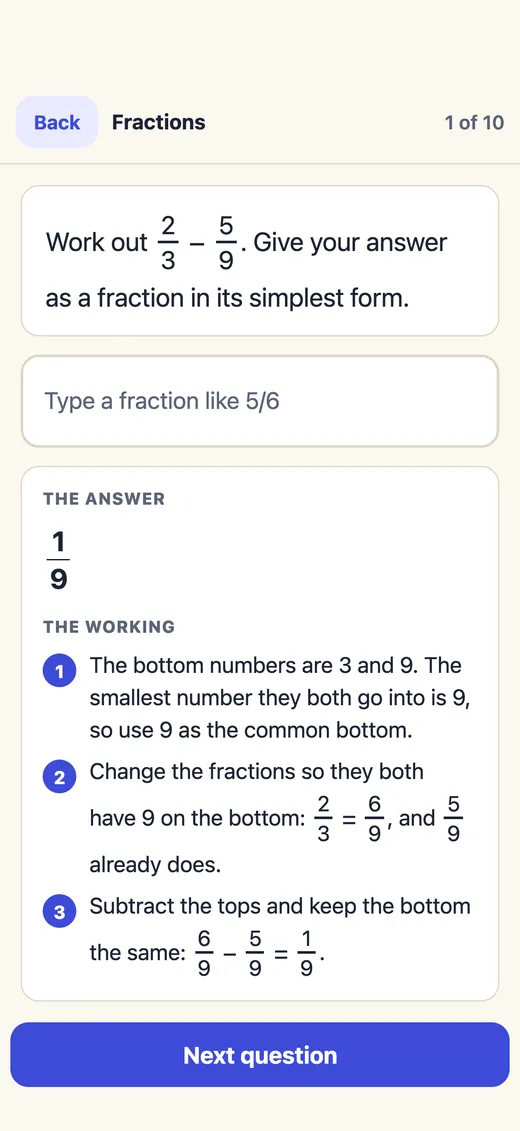
The worked answer in Show Working: the answer, then numbered steps in plain words

Show WorkingComing soon to the App Store