

Show Working

StatisticsFoundation and Higher

Samples and populations GCSE questions with answers

8 samples and populations questions to try, each with the answer and the full working one tap away. Every question here was made and worked out by the Show Working maths engine, not typed in by hand.

This topic uses a sample to estimate something about a whole population, such as how many people at a festival live in London. It also covers capture-recapture, which estimates the size of an animal population from how many marked animals are caught again.

Quiz yourself: 8 questions

Worked example 1: estimating from a sample

In a survey of 40 pupils at a school, 12 said they walk to school. There are 750 pupils at the school. Estimate how many pupils at the school walk to school.

  1. In the sample, 12 out of 40 is 1240.
  2. Assume the same fraction of the whole population: 1240 × 750 = 225.

Answer 225
01 / Quiz yourselfTry it, then tap to check

Samples and populations questions to try

Work each one out on paper first. Then open the answer and compare your working with ours, step by step.

01 / Estimating from a sampleBoth tiers

In a survey of 50 pupils at a school, 16 said they walk to school. There are 1,500 pupils at the school. Estimate how many pupils at the school walk to school.

Show the answer and working
  1. In the sample, 16 out of 50 is 1650.
  2. Assume the same fraction of the whole population: 1650 × 1500 = 480.

Answer 480

02 / Estimating from a sampleBoth tiers

At a music festival, 80 people were picked at random and asked where they live. 21 of them live in London. 6,000 people went to the festival. Estimate how many of the people at the festival live in London.

Show the answer and working
  1. In the sample, 21 out of 80 is 2180.
  2. Assume the same fraction of the whole population: 2180 × 6000 = 1,575.

Answer 1,575

03 / Estimating from a sampleBoth tiers

In a survey of 60 pupils at a school, 17 said they walk to school. There are 1,500 pupils at the school. Estimate how many pupils at the school walk to school.

Show the answer and working
  1. In the sample, 17 out of 60 is 1760.
  2. Assume the same fraction of the whole population: 1760 × 1500 = 425.

Answer 425

04 / Estimating from a sampleBoth tiers

A factory tests a sample of 200 light bulbs and finds that 9 of them are faulty. The factory makes 10,000 bulbs a day. Estimate how many of the bulbs made in a day are faulty.

Show the answer and working
  1. In the sample, 9 out of 200 is 9200.
  2. Assume the same fraction of the whole population: 9200 × 10000 = 450.

Answer 450

05 / Capture-recaptureBoth tiers

A wildlife officer wants to estimate how many newts live in a pond. She catches 20 newts, marks each one and lets them go. A week later she catches 75 newts. 2 of these are marked. Work out an estimate for the number of newts in the pond.

Show the answer and working
  1. In the second catch, 2 out of 75 are marked: 275.
  2. Assume the same fraction of the whole population is marked: 20 out of N.
  3. So 20N = 275, which gives N = 20 × 75 ÷ 2 = 750.
  4. This assumes the number of newts does not change between the two catches (none are born, die, arrive or leave), the marked newts mix back in with the rest, and the marks do not come off.

Answer 750

06 / Capture-recaptureBoth tiers

A scientist wants to estimate how many fish live in a lake. She catches 60 fish, puts a small tag on each one and lets them go. A week later she catches 80 fish. 15 of these are marked. Work out an estimate for the number of fish in the lake.

Show the answer and working
  1. In the second catch, 15 out of 80 are marked: 1580.
  2. Assume the same fraction of the whole population is marked: 60 out of N.
  3. So 60N = 1580, which gives N = 60 × 80 ÷ 15 = 320.
  4. This assumes the number of fish does not change between the two catches (none are born, die, arrive or leave), the marked fish mix back in with the rest, and the marks do not come off.

Answer 320

07 / Capture-recaptureBoth tiers

A scientist wants to estimate how many fish live in a lake. She catches 30 fish, puts a small tag on each one and lets them go. A week later she catches 50 fish. 10 of these are marked. Work out an estimate for the number of fish in the lake.

Show the answer and working
  1. In the second catch, 10 out of 50 are marked: 1050.
  2. Assume the same fraction of the whole population is marked: 30 out of N.
  3. So 30N = 1050, which gives N = 30 × 50 ÷ 10 = 150.
  4. This assumes the number of fish does not change between the two catches (none are born, die, arrive or leave), the marked fish mix back in with the rest, and the marks do not come off.

Answer 150

08 / Capture-recaptureBoth tiers

An ecologist wants to estimate how many rabbits live in a wood. She catches 45 rabbits, marks each one and lets them go. She thinks there are about 100 rabbits in the wood. A week later she catches 40 rabbits. How many of these would you expect to be marked?

Show the answer and working
  1. The fraction of the whole population that is marked is 45100.
  2. Expect the same fraction of the second catch to be marked: 45100 × 40 = 18.
  3. This assumes the marked rabbits have mixed back in with the rest, and the number of rabbits has not changed in between.

Answer 18

02 / What's covered2 kinds of question

Samples and populations at GCSE and where marks go

  • Estimating from a sampleBoth tiers
  • Capture-recaptureBoth tiers

Worked example 2: capture-recapture

An ecologist wants to estimate how many rabbits live in a wood. She catches 70 rabbits, marks each one and lets them go. She thinks there are about 140 rabbits in the wood. A week later she catches 20 rabbits. How many of these would you expect to be marked?

  1. The fraction of the whole population that is marked is 70140.
  2. Expect the same fraction of the second catch to be marked: 70140 × 20 = 10.
  3. This assumes the marked rabbits have mixed back in with the rest, and the number of rabbits has not changed in between.

Answer 10

A common mistake

Setting up the capture-recapture fraction upside down. If 20 newts are marked and later 10 of the 60 caught are marked, then 1 in 6 newts is marked, so there are about 20 × 6 = 120, not 10 × 60 ÷ 20 = 30.

03 / Practise itiPhone and iPad

More samples and populations questions in Show Working

In the app, Samples and populations makes fresh questions every time, so they never run out. Tap Show me one to see a new worked example straight away, or practise ten and open the working whenever you are stuck. Forgotten a method? Type it into Look up and the answer is there.

Coming soon to the App Store

More statistics topics

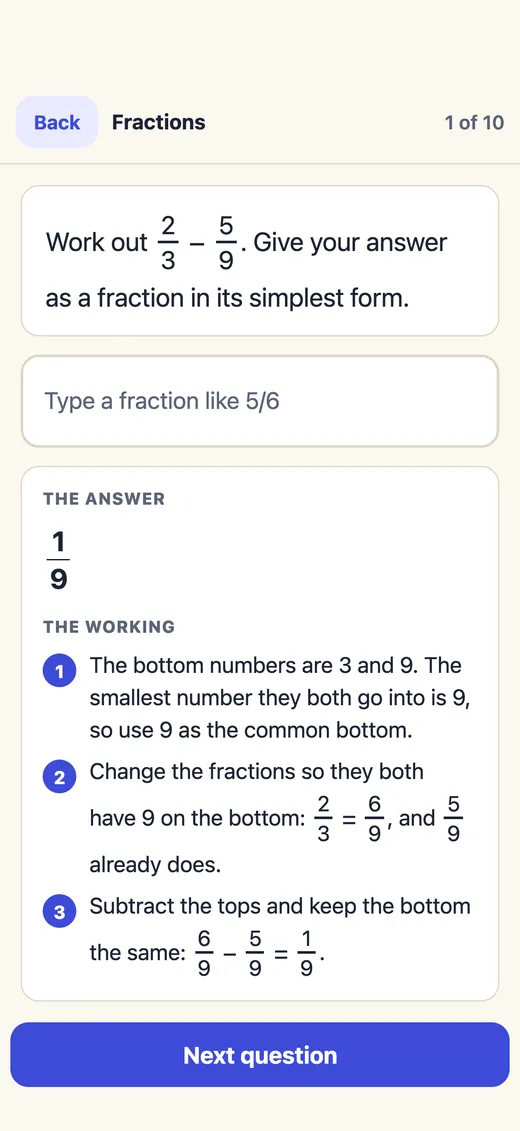
The worked answer in Show Working: the answer, then numbered steps in plain words

Show WorkingComing soon to the App Store