

Show Working

Ratio, proportion and rates of changeFoundation and Higher

Speed, density and pressure GCSE questions with answers

8 speed, density and pressure questions to try, each with the answer and the full working one tap away. Every question here was made and worked out by the Show Working maths engine, not typed in by hand.

Compound measures combine two units, like speed in km/h, density in g/cm³ and pressure in N/m². Questions ask you to use the formula that links the three quantities and to change between km/h and m/s.

Quiz yourself: 8 questions

Worked example 1: speed, distance and time

A car travels 80 km in 1 hour 15 minutes. Work out the average speed in km/h.

  1. Change the time into hours: 15 minutes = 1560 of an hour, so 1 hour 15 minutes = 1.25 hours.
  2. Speed = distance ÷ time = 80 ÷ 1.25 = 64 km/h.

Answer 64 km/h
01 / Quiz yourselfTry it, then tap to check

Speed, density and pressure questions to try

Work each one out on paper first. Then open the answer and compare your working with ours, step by step.

01 / Speed, distance and timeBoth tiers

A train travels 405 km in 3 hours 45 minutes. Work out the average speed in km/h.

Show the answer and working
  1. Change the time into hours: 45 minutes = 4560 of an hour, so 3 hours 45 minutes = 3.75 hours.
  2. Speed = distance ÷ time = 405 ÷ 3.75 = 108 km/h.

Answer 108 km/h

02 / Speed, distance and timeBoth tiers

A car travels 75 km in 50 minutes. Work out the average speed in km/h.

Show the answer and working
  1. Change the time into hours: 50 minutes = 5060 of an hour.
  2. Speed = distance ÷ time = 75 ÷ 5060 = 75 × 60 ÷ 50 = 90 km/h.

Answer 90 km/h

03 / Density, mass and volumeBoth tiers

A piece of pine wood has a mass of 19 g. The density of pine wood is 0.5 g/cm³. Work out the volume of the piece of pine wood. (Density = mass ÷ volume.)

You can use a calculator for this one.

Show the answer and working
  1. Density = mass ÷ volume, so volume = mass ÷ density.
  2. 19 ÷ 0.5 = 38 cm³.

Answer 38 cm³

04 / Density, mass and volumeBoth tiers

A block of silver has a mass of 2,478 g and a volume of 236 cm³. Work out the density of silver in g/cm³. (Density = mass ÷ volume.)

You can use a calculator for this one.

Show the answer and working
  1. Density = mass ÷ volume.
  2. 2,478 ÷ 236 = 10.5 g/cm³.

Answer 10.5 g/cm³

05 / Changing km/h to m/s and backBoth tiers

A swimmer swims at 1.5 m/s. Change this speed into kilometres per hour (km/h).

Show the answer and working
  1. 1.5 m/s means 1.5 metres every second.
  2. There are 60 × 60 = 3600 seconds in an hour, so in 1 hour it goes 1.5 × 3600 = 5,400 m.
  3. 1 km = 1000 m, so that is 5,400 ÷ 1000 = 5.4 km. The speed is 5.4 km/h.

Answer 5.4 km/h

06 / Changing km/h to m/s and backBoth tiers

A lift goes up at 18 km/h. Change this speed into metres per second (m/s).

Show the answer and working
  1. 18 km/h means 18 km in 1 hour.
  2. 1 km = 1000 m, so 18 km = 18 × 1000 = 18,000 m.
  3. 1 hour = 60 × 60 = 3600 seconds.
  4. So the speed is 18,000 ÷ 3600 = 5 metres per second.

Answer 5 m/s

07 / Pressure, force and areaBoth tiers

A force of 2,820 N acts on an area of 3 m². Work out the pressure in N/m². Pressure = force ÷ area.

You can use a calculator for this one.

Show the answer and working
  1. Pressure = force ÷ area.
  2. 2,820 ÷ 3 = 940 N/m².

Answer 940 N/m²

08 / Pressure, force and areaBoth tiers

The pressure on a surface is 380 N/m². The area of the surface is 0.8 m². Work out the force on the surface in newtons (N). Pressure = force ÷ area.

You can use a calculator for this one.

Show the answer and working
  1. Pressure = force ÷ area. So force = pressure × area.
  2. 380 × 0.8 = 304 N.

Answer 304 N

02 / What's covered4 kinds of question

Speed, density and pressure at GCSE and where marks go

  • Speed, distance and timeBoth tiers
  • Density, mass and volumeBoth tiers
  • Changing km/h to m/s and backBoth tiers
  • Pressure, force and areaBoth tiers

Worked example 2: pressure, force and area

A force of 360 N acts on an area of 3 m². Work out the pressure in N/m². Pressure = force ÷ area.

You can use a calculator for this one.

  1. Pressure = force ÷ area.
  2. 360 ÷ 3 = 120 N/m².

Answer 120 N/m²

A common mistake

Writing hours and minutes as a decimal the wrong way. 2 hours 30 minutes is 2.5 hours, not 2.3, so 150 km in that time is 150 ÷ 2.5 = 60 km/h.

03 / Practise itiPhone and iPad

More speed, density and pressure questions in Show Working

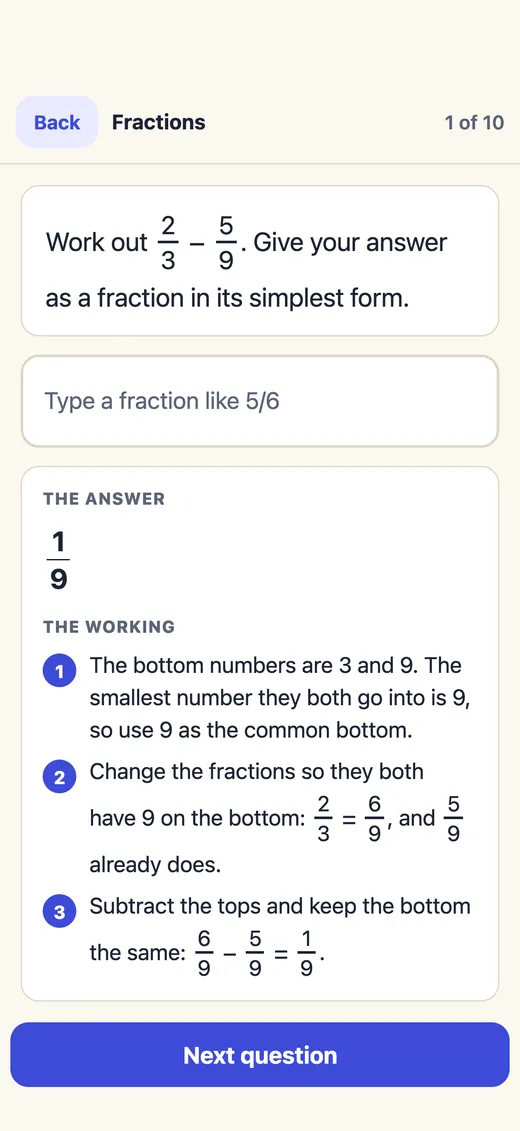
In the app, Speed, density and pressure makes fresh questions every time, so they never run out. Tap Show me one to see a new worked example straight away, or practise ten and open the working whenever you are stuck. Forgotten a method? Type it into Look up and the answer is there.

Coming soon to the App Store

More ratio, proportion and rates of change topics

The worked answer in Show Working: the answer, then numbered steps in plain words

Show WorkingComing soon to the App Store