Show Working

Ratio, proportion and rates of changeFoundation and Higher (some Higher only)

Direct and inverse proportion GCSE questions with answers

8 direct and inverse proportion questions to try, each with the answer and the full working one tap away. Every question here was made and worked out by the Show Working maths engine, not typed in by hand.

Proportion questions include scaling a recipe, finding which of two offers is better value, and direct and inverse proportion. On Higher you also write the relationship with a constant k, such as y = kx² or y = k/x.

Quiz yourself: 8 questions

Worked example 1: scaling a recipe

Here is a recipe for 8 pancakes. Chloe wants to make 13 pancakes. How much milk does Chloe need?

IngredientAmountPlain flour120 gMilk300 mlEggs2Butter20 g
  1. Find the amount for 1 pancake first: 300 ml ÷ 8 = 37.5 ml.
  2. Then multiply by 13: 37.5 ml × 13 = 487.5 ml.

Answer 487.5 ml

01 / Quiz yourselfTry it, then tap to check

Direct and inverse proportion questions to try

Work each one out on paper first. Then open the answer and compare your working with ours, step by step.

01 / Scaling a recipeBoth tiers

Here is a recipe for 8 pancakes. Jack wants to make 31 pancakes. How much milk does Jack need?

IngredientAmountPlain flour120 gMilk300 mlEggs2Butter20 g
Show the answer and working
  1. Find the amount for 1 pancake first: 300 ml ÷ 8 = 37.5 ml.
  2. Then multiply by 31: 37.5 ml × 31 = 1,162.5 ml.

Answer 1,162.5 ml

02 / Scaling a recipeBoth tiers

Here is a recipe for 12 flapjacks. Ella wants to make 29 flapjacks. How many grams of butter does Ella need?

IngredientAmountOats240 gButter120 gGolden syrup90 gBrown sugar60 g
Show the answer and working
  1. Find the amount for 1 flapjack first: 120 g ÷ 12 = 10 g.
  2. Then multiply by 29: 10 g × 29 = 290 g.

Answer 290 g

03 / Best buy: which is better value?Both tiers

A shop sells rice in two sizes. Bag A: 1.5 kg for £3.90. Bag B: 1 kg for £2.90. Which bag is better value for money?

Show the answer and working
  1. Compare the cost of the same amount. Work out the price of 100 g in each bag.
  2. Bag A: 1.5 kg = 1,500 g, which is 15 lots of 100 g. £3.90 ÷ 15 = 26p for 100 g.
  3. Bag B: 1 kg = 1,000 g, which is 10 lots of 100 g. £2.90 ÷ 10 = 29p for 100 g.
  4. 26p is less than 29p, so bag A is better value.

Answer Bag A

04 / Best buy: which is better value?Both tiers

A shop sells cans of lemonade in two sizes. Pack A: 8 cans for £5.52. Pack B: 6 cans for £4.38. Which pack is better value for money?

Show the answer and working
  1. Compare the cost of the same amount. Work out the price of one can in each pack.
  2. Pack A: £5.52 ÷ 8 = 69p for one can.
  3. Pack B: £4.38 ÷ 6 = 73p for one can.
  4. 69p is less than 73p, so pack A is better value.

Answer Pack A

05 / Direct proportion: the unitary methodBoth tiers

Jack is paid £69.00 for 5 hours of work. How much is Jack paid for 8 hours at the same rate of pay?

Show the answer and working
  1. Find the pay for one hour first: £69.00 ÷ 5 = £13.80.
  2. Then multiply by 8: 8 × £13.80 = £110.40.

Answer £110.40

06 / Direct proportion: the unitary methodBoth tiers

A printer prints 156 pages in 3 minutes. At the same rate, how many pages does it print in 5 minutes?

Show the answer and working
  1. Find the amount for one minute first: 156 ÷ 3 = 52 pages.
  2. Then multiply by 5: 5 × 52 = 260 pages.

Answer 260 pages

07 / Inverse proportionBoth tiers

10 machines take 14 hours to print a batch of leaflets. How many hours would 20 machines take? Assume they all work at the same rate.

Show the answer and working
  1. More machines finish the job faster, so this is inverse proportion.
  2. 1 machine on its own would take 10 × 14 = 140 hours.
  3. 20 machines: 140 ÷ 20 = 7 hours.

Answer 7 hours

08 / Direct and inverse proportion with kHigher only

y is directly proportional to x. When x = 10, y = 90. Work out the value of y when x = 8.

Show the answer and working
  1. Write the proportion as a formula with a constant k: y = kx.
  2. Put in x = 10 and y = 90: 90 = k × 10.
  3. So k = 90 ÷ 10 = 9, and the formula is y = 9x.
  4. When x = 8: y = 9 × 8 = 72.

Answer 72

02 / What's covered5 kinds of question

Direct and inverse proportion at GCSE and where marks go

  • Scaling a recipeBoth tiers
  • Best buy: which is better value?Both tiers
  • Direct proportion: the unitary methodBoth tiers
  • Inverse proportionBoth tiers
  • Direct and inverse proportion with kHigher only

Worked example 2: direct and inverse proportion with k

F is directly proportional to the square of r. When r = 2, F = 4.8. Work out the value of r when F = 10.8. r is positive.

  1. Write the proportion as a formula with a constant k: F = kr2.
  2. Put in r = 2 and F = 4.8: 4.8 = k × 22, so 4.8 = 4k.
  3. So k = 4.8 ÷ 4 = 1.2, and the formula is F = 1.2r2.
  4. When F = 10.8: 10.8 = 1.2r2, so r2 = 10.8 ÷ 1.2 = 9.
  5. r is positive, so r = √9 = 3.

Answer 3

A common mistake

Treating inverse proportion like direct proportion. If 4 workers take 6 days to do a job, 8 workers take 3 days, not 12. Twice as many workers means half the time.

03 / Practise itiPhone and iPad

More direct and inverse proportion questions in Show Working

In the app, Direct and inverse proportion makes fresh questions every time, so they never run out. Tap Show me one to see a new worked example straight away, or practise ten and open the working whenever you are stuck. Forgotten a method? Type it into Look up and the answer is there.

Coming soon to the App Store

More ratio, proportion and rates of change topics

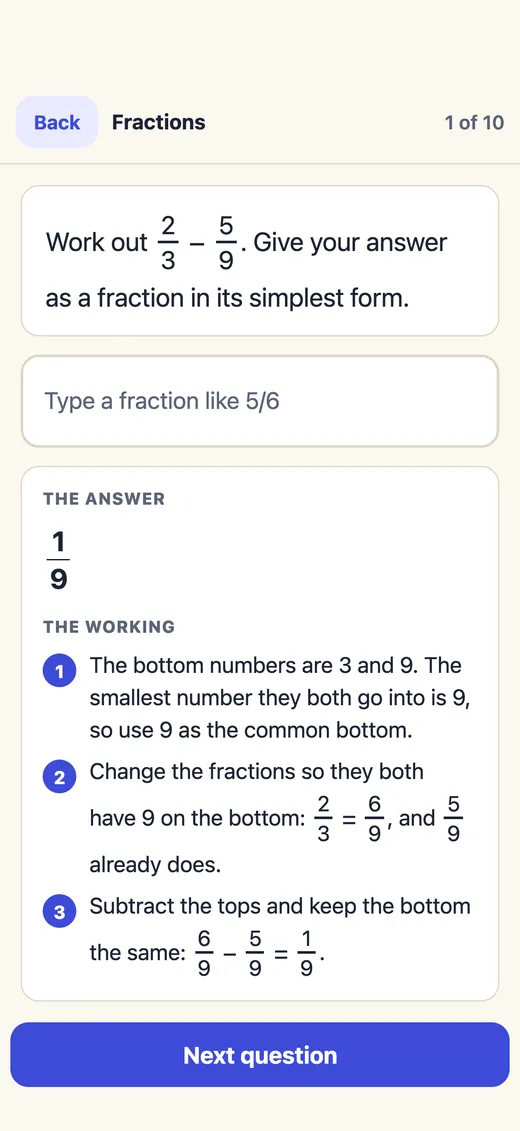
The worked answer in Show Working: the answer, then numbered steps in plain words

Show WorkingComing soon to the App Store