Show Working

AlgebraHigher

Functions GCSE questions with answers

8 functions questions to try, each with the answer and the full working one tap away. Every question here was made and worked out by the Show Working maths engine, not typed in by hand.

Function questions on Higher use notation like f(x) = 3x + 1. You work out values such as f(4), find inverse functions and combine two functions into a composite function like gf(x).

Quiz yourself: 8 questions

Worked example 1: function notation

f(x) = 4x − 3
Work out f(−5).

  1. f(−5) means put x = −5 into the expression.
  2. f(−5) = 4(−5) − 3 = −23.

Answer −23

01 / Quiz yourselfTry it, then tap to check

Functions questions to try

Work each one out on paper first. Then open the answer and compare your working with ours, step by step.

01 / Function notationHigher only

f(x) = x2 + 9
Work out f(3).

Show the answer and working
  1. f(3) means put x = 3 into the expression.
  2. f(3) = (3)2 + 9 = 18.

Answer 18

02 / Function notationHigher only

f(x) = 2x2 − 2
g(x) = −3x − 3
Work out gf(4).

Show the answer and working
  1. gf(4) means work out f(4) first, then put the answer into g.
  2. f(4) = 2(4)2 − 2 = 30.
  3. g(30) = −3(30) − 3 = −93.

Answer −93

03 / Function notationHigher only

f(x) = −3x + 2
Work out f(4).

Show the answer and working
  1. f(4) means put x = 4 into the expression.
  2. f(4) = −3(4) + 2 = −10.

Answer −10

04 / Function notationHigher only

f(x) = 6x − 4
Work out f(6).

Show the answer and working
  1. f(6) means put x = 6 into the expression.
  2. f(6) = 6(6) − 4 = 32.

Answer 32

05 / Inverse and composite functionsHigher only

f(x) = −2x − 8
g(x) = 5x + 6
Find fg(x). Simplify your answer.

Show the answer and working
  1. fg(x) means put g(x) into f: replace every x in f(x) with (5x + 6).
  2. fg(x) = −2(5x + 6) − 8.
  3. Expand and simplify: −10x − 20.

Answer fg(x) = −10x − 20

06 / Inverse and composite functionsHigher only

f(x) = x6 − 1
Find f−1(x).

Show the answer and working
  1. Write y = x6 − 1 and make x the subject.
  2. Add 1: y + 1 = x6. Multiply by 6: x = 6(y + 1).
  3. Swap y for x: f−1(x) = 6(x + 1).
  4. Check: put a number into f, then put the answer into the inverse. You get the number back.

Answer f−1(x) = 6(x + 1)

07 / Inverse and composite functionsHigher only

f(x) = 4x + 2
Find f−1(x).

Show the answer and working
  1. Write y = 4x + 2 and make x the subject.
  2. Subtract 2: y − 2 = 4x. Divide by 4: x = y − 24.
  3. Swap y for x: f−1(x) = (x − 2)÷4.
  4. Check: put a number into f, then put the answer into the inverse. You get the number back.

Answer f−1(x) = (x − 2)÷4

08 / Inverse and composite functionsHigher only

f(x) = x + 73
Find f−1(x).

Show the answer and working
  1. Write y = x + 73 and make x the subject.
  2. Multiply by 3: 3y = x + 7. Subtract 7: x = 3y − 7.
  3. Swap y for x: f−1(x) = 3x − 7.
  4. Check: put a number into f, then put the answer into the inverse. You get the number back.

Answer f−1(x) = 3x − 7

02 / What's covered2 kinds of question

Functions at GCSE and where marks go

  • Function notationHigher only
  • Inverse and composite functionsHigher only

Worked example 2: inverse and composite functions

f(x) = x2 + 9
Find f−1(x).

  1. Write y = x2 + 9 and make x the subject.
  2. Subtract 9: y − 9 = x2. Multiply by 2: x = 2(y − 9).
  3. Swap y for x: f−1(x) = 2(x − 9).
  4. Check: put a number into f, then put the answer into the inverse. You get the number back.

Answer f−1(x) = 2(x − 9)

A common mistake

Doing a composite function in the wrong order. gf(x) means do f first, then g. If f(x) = 3x + 1 and g(x) = 5x − 3, then gf(x) = 5(3x + 1) − 3 = 15x + 2.

03 / Practise itiPhone and iPad

More functions questions in Show Working

In the app, Functions makes fresh questions every time, so they never run out. Tap Show me one to see a new worked example straight away, or practise ten and open the working whenever you are stuck. Forgotten a method? Type it into Look up and the answer is there.


Coming soon to the App Store
More algebra topics

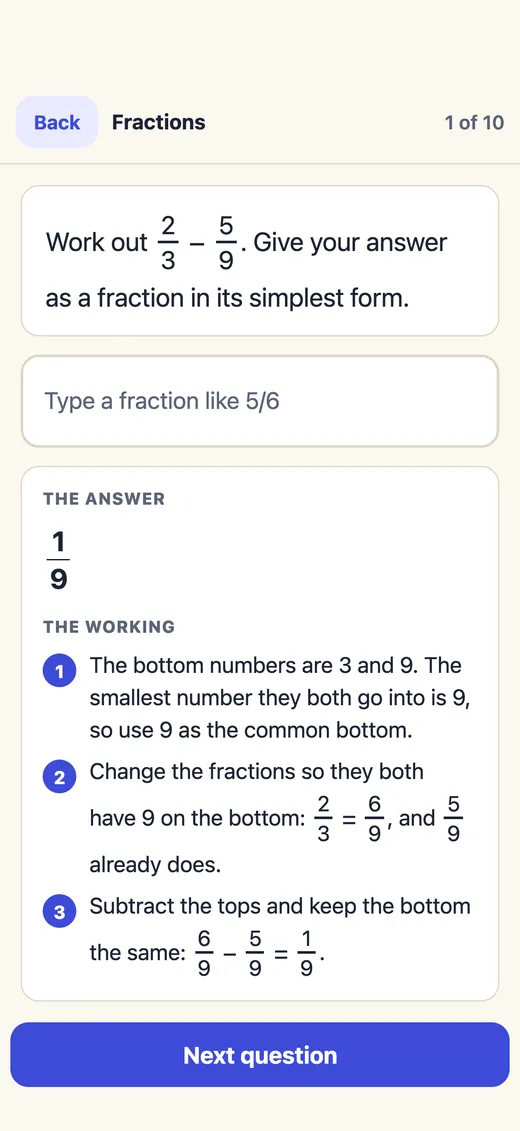
The worked answer in Show Working: the answer, then numbered steps in plain words

Show WorkingComing soon to the App Store