Show Working

Geometry and measuresFoundation and Higher

Area and perimeter GCSE questions with answers

8 area and perimeter questions to try, each with the answer and the full working one tap away. Every question here was made and worked out by the Show Working maths engine, not typed in by hand.

Area and perimeter questions cover rectangles, triangles, parallelograms, trapeziums and L-shapes. Perimeter is the distance round the outside, and area is the space inside, measured in square units.

Quiz yourself: 8 questions

Worked example 1: area of rectangles, triangles and parallelograms

Work out the perimeter of the rectangle.

6 cm7 cm
Not drawn accurately
  1. The perimeter is the distance all the way round.
  2. A rectangle has two sides of 7 cm and two of 6 cm.
  3. 7 + 6 + 7 + 6 = 26 cm.

Answer 26 cm

01 / Quiz yourselfTry it, then tap to check

Area and perimeter questions to try

Work each one out on paper first. Then open the answer and compare your working with ours, step by step.

01 / Area of rectangles, triangles and parallelogramsBoth tiers

Work out the area of the rectangle.

12 cm8 cm
Not drawn accurately
Show the answer and working
  1. Area of a rectangle = length × width.
  2. 8 × 12 = 96 cm².

Answer 96 cm²

02 / Area of rectangles, triangles and parallelogramsBoth tiers

Work out the area of the rectangle.

6 m12 m
Not drawn accurately
Show the answer and working
  1. Area of a rectangle = length × width.
  2. 12 × 6 = 72 m².

Answer 72 m²

03 / Area of rectangles, triangles and parallelogramsBoth tiers

Work out the area of the rectangle.

5 m13 m
Not drawn accurately
Show the answer and working
  1. Area of a rectangle = length × width.
  2. 13 × 5 = 65 m².

Answer 65 m²

04 / Area of a trapeziumBoth tiers

Work out the area of the trapezium.

9 cm7 cm8 cm
Not drawn accurately
Show the answer and working
  1. Area of a trapezium = ½ × (a + b) × h, where a and b are the parallel sides and h is the height between them.
  2. a + b = 7 + 9 = 16.
  3. ½ × 16 × 8 = 64 cm².

Answer 64 cm²

05 / Area of a trapeziumBoth tiers

Work out the area of the trapezium.

6 m3 m10 m
Not drawn accurately
Show the answer and working
  1. Area of a trapezium = ½ × (a + b) × h, where a and b are the parallel sides and h is the height between them.
  2. a + b = 3 + 6 = 9.
  3. ½ × 9 × 10 = 45 m².

Answer 45 m²

06 / Area of a trapeziumBoth tiers

Work out the area of the trapezium.

10 m5 m5 m
Not drawn accurately
Show the answer and working
  1. Area of a trapezium = ½ × (a + b) × h, where a and b are the parallel sides and h is the height between them.
  2. a + b = 5 + 10 = 15.
  3. ½ × 15 × 5 = 37.5 m².

Answer 37.5 m²

07 / Area and perimeter of L-shapesBoth tiers

Work out the area of the shape. All the corners are right angles.

6 m6 m13 m10 m
Not drawn accurately
Show the answer and working
  1. Split the shape into two rectangles. The missing sides are 13 − 6 = 7 m and 10 − 6 = 4 m.
  2. Left rectangle: 6 × 10 = 60 m². Right rectangle: 7 × 6 = 42 m².
  3. Total: 60 + 42 = 102 m².

Answer 102 m²

08 / Area and perimeter of L-shapesBoth tiers

Work out the perimeter of the shape. All the corners are right angles.

6 cm4 cm10 cm8 cm
Not drawn accurately
Show the answer and working
  1. Find the two missing sides first. Across the top step: 10 − 6 = 4 cm. Down the step: 8 − 4 = 4 cm.
  2. Add all six sides: 6 + 4 + 4 + 4 + 10 + 8 = 36 cm.

Answer 36 cm

02 / What's covered3 kinds of question

Area and perimeter at GCSE and where marks go

  • Area of rectangles, triangles and parallelogramsBoth tiers
  • Area of a trapeziumBoth tiers
  • Area and perimeter of L-shapesBoth tiers

Worked example 2: area and perimeter of l-shapes

Work out the perimeter of the shape. All the corners are right angles.

8 cm3 cm10 cm13 cm
Not drawn accurately
  1. Find the two missing sides first. Across the top step: 10 − 8 = 2 cm. Down the step: 13 − 3 = 10 cm.
  2. Add all six sides: 8 + 10 + 2 + 3 + 10 + 13 = 46 cm.

Answer 46 cm

A common mistake

Using the sloping side instead of the height. The area of a triangle is ½ × base × height, where the height is at right angles to the base, so a base of 10 cm and a height of 6 cm give 30 cm².

03 / Practise itiPhone and iPad

More area and perimeter questions in Show Working

In the app, Area and perimeter makes fresh questions every time, so they never run out. Tap Show me one to see a new worked example straight away, or practise ten and open the working whenever you are stuck. Forgotten a method? Type it into Look up and the answer is there.


Coming soon to the App Store
More geometry and measures topics

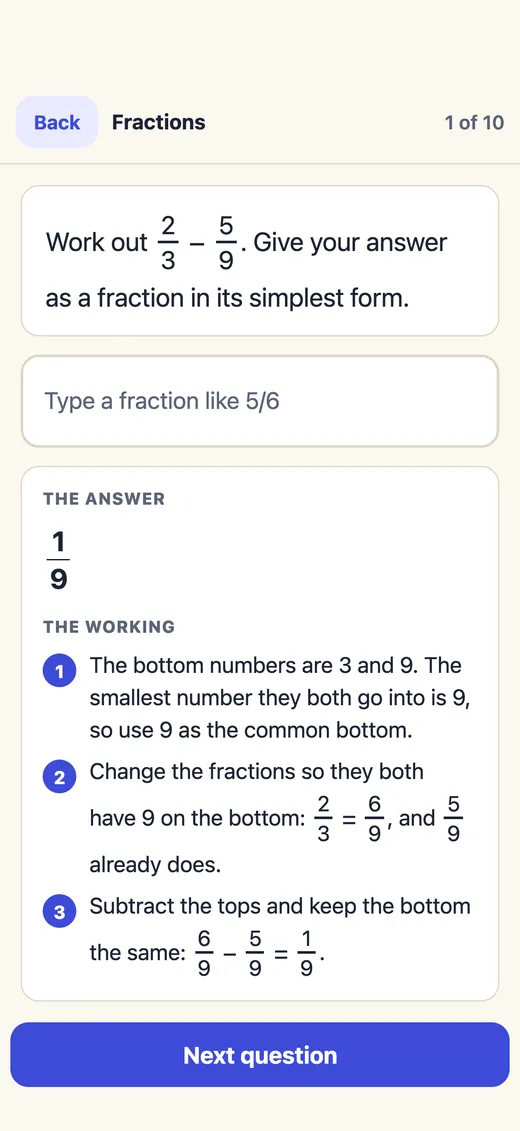
The worked answer in Show Working: the answer, then numbered steps in plain words

Show WorkingComing soon to the App Store