Show Working

Geometry and measuresFoundation and Higher (some Higher only)

Pythagoras GCSE questions with answers

8 Pythagoras questions to try, each with the answer and the full working one tap away. Every question here was made and worked out by the Show Working maths engine, not typed in by hand.

Pythagoras’ theorem, a² + b² = c², links the three sides of a right-angled triangle, where c is the longest side. You use it to find the longest side, a shorter side and the distance between two points, and on Higher in 3D shapes too.

Quiz yourself: 8 questions

Worked example 1: find the longest side

Work out the length of the side marked x.

8 cm15 cmx
Not drawn accurately

You can use a calculator for this one.

  1. The side marked x is opposite the right angle, so it is the longest side (the hypotenuse).
  2. Pythagoras: x² = 8² + 15² = 64 + 225 = 289.
  3. x = √289 = 17

Answer 17 cm

01 / Quiz yourselfTry it, then tap to check

Pythagoras questions to try

Work each one out on paper first. Then open the answer and compare your working with ours, step by step.

01 / Find the longest sideBoth tiers

Work out the length of the side marked x. Give your answer to 1 decimal place.

12 cm6 cmx
Not drawn accurately

You can use a calculator for this one.

Show the answer and working
  1. The side marked x is opposite the right angle, so it is the longest side (the hypotenuse).
  2. Pythagoras: x² = 12² + 6² = 144 + 36 = 180.
  3. x = √180 = 13.4164…
  4. To 1 decimal place: 13.4 cm.

Answer 13.4 cm

02 / Find the longest sideBoth tiers

Work out the length of the side marked x.

40 cm9 cmx
Not drawn accurately

You can use a calculator for this one.

Show the answer and working
  1. The side marked x is opposite the right angle, so it is the longest side (the hypotenuse).
  2. Pythagoras: x² = 40² + 9² = 1600 + 81 = 1681.
  3. x = √1681 = 41

Answer 41 cm

03 / Find a shorter sideBoth tiers

Work out the length of the side marked x.

20 mx29 m
Not drawn accurately

You can use a calculator for this one.

Show the answer and working
  1. The longest side (opposite the right angle) is 29 m, and x is one of the shorter sides.
  2. Pythagoras: x² + 20² = 29², so x² = 29² − 20² = 841 − 400 = 441.
  3. x = √441 = 21

Answer 21 m

04 / Find a shorter sideBoth tiers

Work out the length of the side marked x.

15 cmx17 cm
Not drawn accurately

You can use a calculator for this one.

Show the answer and working
  1. The longest side (opposite the right angle) is 17 cm, and x is one of the shorter sides.
  2. Pythagoras: x² + 15² = 17², so x² = 17² − 15² = 289 − 225 = 64.
  3. x = √64 = 8

Answer 8 cm

05 / Distance between two pointsBoth tiers

A is the point (0, 1) and B is the point (−2, 4). Work out the length of AB. Give your answer to 1 decimal place.

−6−4−224−6−4−2240xyAB

You can use a calculator for this one.

Show the answer and working
  1. Make a right-angled triangle with AB as its longest side: one side goes across, the other goes up or down.
  2. Across: −2 − 0 = −2. Up or down: 4 − 1 = 3.
  3. AB² = (−2)² + 3² = 4 + 9 = 13.
  4. AB = √13 = 3.6056…
  5. To 1 decimal place: 3.6.

Answer 3.6

06 / Distance between two pointsBoth tiers

A is the point (5, 1) and B is the point (−4, 4). Work out the length of AB. Give your answer to 1 decimal place.

−6−4−224−6−4−2240xyAB

You can use a calculator for this one.

Show the answer and working
  1. Make a right-angled triangle with AB as its longest side: one side goes across, the other goes up or down.
  2. Across: −4 − 5 = −9. Up or down: 4 − 1 = 3.
  3. AB² = (−9)² + 3² = 81 + 9 = 90.
  4. AB = √90 = 9.4868…
  5. To 1 decimal place: 9.5.

Answer 9.5

07 / Pythagoras in 3DHigher only

The diagram shows a cuboid ABCDEFGH. AB = 10 cm, BC = 5 cm and the diagonal AG = 17 cm. Work out the height AE, marked x. Give your answer to 1 decimal place.

10 cm5 cmxABCDEFGH
Not drawn accurately

You can use a calculator for this one.

Show the answer and working
  1. For a cuboid, AG² = AB² + BC² + AE² (Pythagoras twice: once for the base diagonal AC, then for triangle ACG).
  2. So x² = AG² − AB² − BC² = 17² − 10² − 5² = 289 − 100 − 25 = 164.
  3. x = √164 = 12.8062…
  4. To 1 decimal place: 12.8 cm.

Answer 12.8 cm

08 / Pythagoras in 3DHigher only

The diagram shows a cuboid ABCDEFGH. AB = 4 cm, BC = 12 cm and AE = 3 cm. Work out the length of the diagonal AG.

4 cm12 cm3 cmABCDEFGH
Not drawn accurately

You can use a calculator for this one.

Show the answer and working
  1. AG goes through the inside of the cuboid. First find AC, the diagonal of the base ABCD.
  2. Triangle ABC has a right angle at B: AC² = 4² + 12² = 160.
  3. Triangle ACG has a right angle at C, and CG = AE = 3 cm: AG² = AC² + CG² = 160 + 9 = 169.
  4. AG = √169 = 13 cm.

Answer 13 cm

02 / What's covered4 kinds of question

Pythagoras at GCSE and where marks go

  • Find the longest sideBoth tiers
  • Find a shorter sideBoth tiers
  • Distance between two pointsBoth tiers
  • Pythagoras in 3DHigher only

Worked example 2: pythagoras in 3d

The diagram shows a cuboid ABCDEFGH. AB = 3 cm, BC = 9 cm and the diagonal AG = 11 cm. Work out the height AE, marked x. Give your answer to 1 decimal place.

3 cm9 cmxABCDEFGH
Not drawn accurately

You can use a calculator for this one.

  1. For a cuboid, AG² = AB² + BC² + AE² (Pythagoras twice: once for the base diagonal AC, then for triangle ACG).
  2. So x² = AG² − AB² − BC² = 11² − 3² − 9² = 121 − 9 − 81 = 31.
  3. x = √31 = 5.5678…
  4. To 1 decimal place: 5.6 cm.

Answer 5.6 cm

A common mistake

Adding the squares when finding a shorter side. If the longest side is 13 cm and another side is 5 cm, the third side is √(13² − 5²) = √144 = 12 cm. For a shorter side you subtract.

03 / Practise itiPhone and iPad

More Pythagoras questions in Show Working

In the app, Pythagoras makes fresh questions every time, so they never run out. Tap Show me one to see a new worked example straight away, or practise ten and open the working whenever you are stuck. Forgotten a method? Type it into Look up and the answer is there.

Coming soon to the App Store

More geometry and measures topics

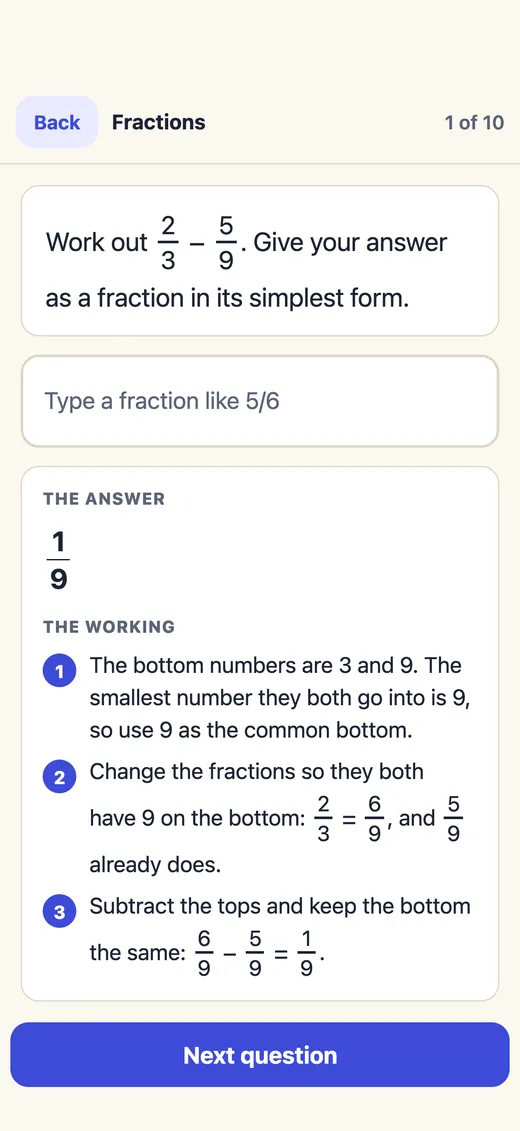
The worked answer in Show Working: the answer, then numbered steps in plain words

Show WorkingComing soon to the App Store