

Show Working

Geometry and measuresFoundation and Higher (some Higher only)

Transformations GCSE questions with answers

8 transformations questions to try, each with the answer and the full working one tap away. Every question here was made and worked out by the Show Working maths engine, not typed in by hand.

Transformation questions ask where a point ends up after a reflection, rotation, translation or enlargement, and how to describe a translation with a column vector. On Higher you also enlarge with a negative scale factor.

Quiz yourself: 8 questions

Worked example 1: describe a translation with a vector

Shape A is translated to shape B. Write the translation as a column vector.

AB
  1. Pick one corner of A and find the matching corner of B.
  2. It moves 6 squares right and 0 squares up or down.
  3. Right and up are positive, left and down are negative. The top number is the move across, the bottom number the move up or down: \vec60.

Answer \vec60
01 / Quiz yourselfTry it, then tap to check

Transformations questions to try

Work each one out on paper first. Then open the answer and compare your working with ours, step by step.

01 / Describe a translation with a vectorBoth tiers

Shape A is translated to shape B. Write the translation as a column vector.

AB
Show the answer and working
  1. Pick one corner of A and find the matching corner of B.
  2. It moves 2 squares left and 3 squares up.
  3. Right and up are positive, left and down are negative. The top number is the move across, the bottom number the move up or down: \vec−23.

Answer \vec−23

02 / Describe a translation with a vectorBoth tiers

Shape A is translated to shape B. Write the translation as a column vector.

AB
Show the answer and working
  1. Pick one corner of A and find the matching corner of B.
  2. It moves 0 squares across and 6 squares up.
  3. Right and up are positive, left and down are negative. The top number is the move across, the bottom number the move up or down: \vec06.

Answer \vec06

03 / Reflect, rotate or translate a pointBoth tiers

P is the point (−5, 2). P is rotated 90° clockwise about the origin. Write down the coordinates of the image of P.

−6−4−224−6−4−2240xyP
Show the answer and working
  1. Picture the line from the origin to P and turn it a quarter turn clockwise (the way clock hands go). Tracing paper helps.
  2. A quarter turn clockwise about the origin takes (x, y) to (y, −x): (−5, 2) becomes (2, 5).
  3. The image of P is (2, 5).

Answer (2, 5)

04 / Reflect, rotate or translate a pointBoth tiers

P is the point (−3, −1). P is reflected in the line y = x. Write down the coordinates of the image of P.

−6−4−224−6−4−2240xyy = xP
Show the answer and working
  1. The line y = x goes through (1, 1), (2, 2) and so on. Reflecting in it swaps the two coordinates.
  2. (−3, −1) becomes (−1, −3).
  3. The image of P is (−1, −3).

Answer (−1, −3)

05 / Enlarge a point from a centreBoth tiers

P is the point (4, 8) and C is the point (6, 6). P is enlarged by scale factor 12 with centre C. Write down the coordinates of the image of P.

2468102468100xyPC
Show the answer and working
  1. From C to P is 2 left and 2 up.
  2. Multiply by 12: 1 left and 1 up.
  3. Start at C and move that far: (6 + (−1), 6 + 1) = (5, 7).

Answer (5, 7)

06 / Enlarge a point from a centreBoth tiers

P is the point (8, 1) and C is the point (7, 1). P is enlarged by scale factor 2 with centre C. Write down the coordinates of the image of P.

2468102468100xyPC
Show the answer and working
  1. From C to P is 1 right.
  2. Multiply by 2: 2 right.
  3. Start at C and move that far: (7 + 2, 1 + 0) = (9, 1).

Answer (9, 1)

07 / Enlargement with a negative scale factorHigher only

P is the point (7, 8) and C is the point (8, 7). P is enlarged by scale factor −1 with centre C. Write down the coordinates of the image of P.

2468102468100xyPC
Show the answer and working
  1. From C to P is 1 left and 1 up.
  2. Multiply by −1. The minus sign means go the opposite way from C: 1 right and 1 down.
  3. Start at C and move that far: (8 + 1, 7 + (−1)) = (9, 6).

Answer (9, 6)

08 / Enlargement with a negative scale factorHigher only

P is the point (9, 1) and C is the point (6, 4). P is enlarged by scale factor −2 with centre C. Write down the coordinates of the image of P.

2468102468100xyPC
Show the answer and working
  1. From C to P is 3 right and 3 down.
  2. Multiply by −2. The minus sign means go the opposite way from C: 6 left and 6 up.
  3. Start at C and move that far: (6 + (−6), 4 + 6) = (0, 10).

Answer (0, 10)

02 / What's covered4 kinds of question

Transformations at GCSE and where marks go

  • Describe a translation with a vectorBoth tiers
  • Reflect, rotate or translate a pointBoth tiers
  • Enlarge a point from a centreBoth tiers
  • Enlargement with a negative scale factorHigher only

Worked example 2: enlargement with a negative scale factor

P is the point (1, 8) and C is the point (7, 8). P is enlarged by scale factor −12 with centre C. Write down the coordinates of the image of P.

2468102468100xyPC
  1. From C to P is 6 left.
  2. Multiply by −12. The minus sign means go the opposite way from C: 3 right.
  3. Start at C and move that far: (7 + 3, 8 + 0) = (10, 8).

Answer (10, 8)

A common mistake

Enlarging from the origin instead of the centre you are given. For P (5, 3), centre (6, 1) and scale factor 2, P is 1 left and 2 up from the centre, so its image is 2 left and 4 up from the centre: (4, 5).

03 / Practise itiPhone and iPad

More transformations questions in Show Working

In the app, Transformations makes fresh questions every time, so they never run out. Tap Show me one to see a new worked example straight away, or practise ten and open the working whenever you are stuck. Forgotten a method? Type it into Look up and the answer is there.

Coming soon to the App Store

More geometry and measures topics

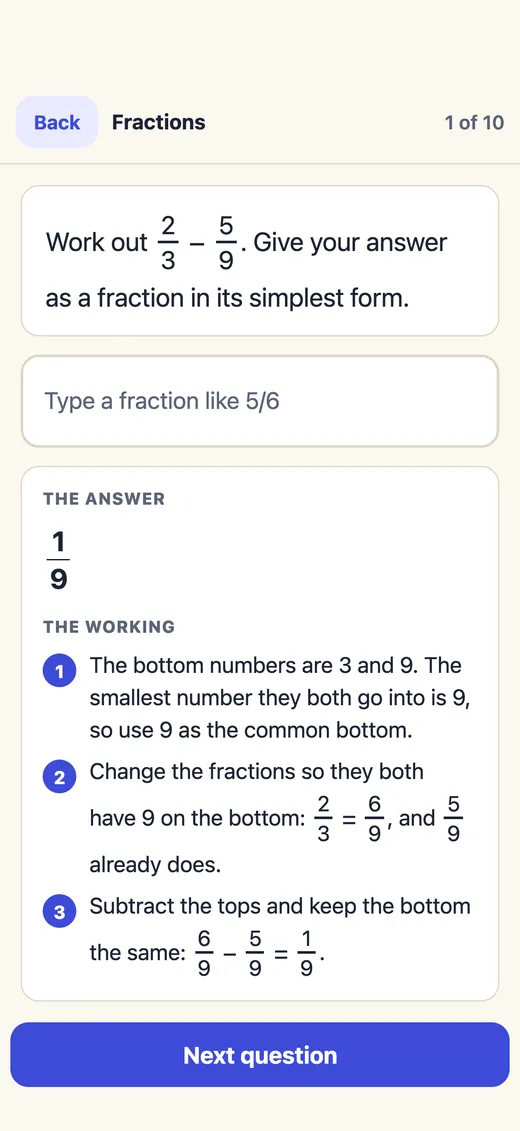
The worked answer in Show Working: the answer, then numbered steps in plain words

Show WorkingComing soon to the App Store