Show Working

NumberFoundation and Higher (some Higher only)

Fractions, decimals and percentages GCSE questions with answers

8 fractions, decimals and percentages questions to try, each with the answer and the full working one tap away. Every question here was made and worked out by the Show Working maths engine, not typed in by hand.

This topic asks you to convert between fractions, decimals and percentages, and to put a mix of them in order of size. On Higher you also turn recurring decimals into fractions.

Quiz yourself: 8 questions

Worked example 1: convert fractions, decimals and percentages

Write 38 as a decimal.

  1. Make the bottom number 1000. 1000 ÷ 8 = 125, so multiply the top and the bottom by 125: 38 = 3751000.
  2. 3751000 is 375 thousandths, which is 0.375.

Answer 0.375

01 / Quiz yourselfTry it, then tap to check

Fractions, decimals and percentages questions to try

Work each one out on paper first. Then open the answer and compare your working with ours, step by step.

01 / Convert fractions, decimals and percentagesBoth tiers

Write 78 as a decimal.

Show the answer and working
  1. Make the bottom number 1000. 1000 ÷ 8 = 125, so multiply the top and the bottom by 125: 78 = 8751000.
  2. 8751000 is 875 thousandths, which is 0.875.

Answer 0.875

02 / Convert fractions, decimals and percentagesBoth tiers

Write 1740 as a decimal.

Show the answer and working
  1. Make the bottom number 1000. 1000 ÷ 40 = 25, so multiply the top and the bottom by 25: 1740 = 4251000.
  2. 4251000 is 425 thousandths, which is 0.425.

Answer 0.425

03 / Convert fractions, decimals and percentagesBoth tiers

Write 78 as a percentage.

Show the answer and working
  1. Divide the top by the bottom: 7 ÷ 8 = 0.875.
  2. Multiply by 100 to change it to a percentage: 0.875 × 100 = 87.5, so it is 87.5%.

Answer 87.5%

04 / Order fractions, decimals and percentagesBoth tiers

Write these numbers in order of size. Start with the smallest.
0.162, 0.07, 0.1, 18, 17%

Show the answer and working
  1. Change each one to a decimal: 18 = 0.125, 17% = 0.17.
  2. Give them all 3 decimal places so they are easy to compare: 0.162, 0.070, 0.100, 0.125, 0.170.
  3. Smallest first: 0.070, 0.100, 0.125, 0.162, 0.170.
  4. So the order is 0.07, 0.1, 18, 0.162, 17%.

Answer 0.07, 0.1, 18, 0.162, 17%

05 / Order fractions, decimals and percentagesBoth tiers

Write these numbers in order of size. Start with the smallest.
45%, 33%, 13, 0.4

Show the answer and working
  1. Change each one to a decimal: 45% = 0.45, 33% = 0.33, 13 = 0.333...
  2. Give them all 3 decimal places so they are easy to compare: 0.450, 0.330, 0.333..., 0.400.
  3. Smallest first: 0.330, 0.333..., 0.400, 0.450.
  4. So the order is 33%, 13, 0.4, 45%.

Answer 33%, 13, 0.4, 45%

06 / Order fractions, decimals and percentagesBoth tiers

Write these numbers in order of size. Start with the smallest.
0.452, 25, 0.5, 35%

Show the answer and working
  1. Change each one to a decimal: 25 = 0.4, 35% = 0.35.
  2. Give them all 3 decimal places so they are easy to compare: 0.452, 0.400, 0.500, 0.350.
  3. Smallest first: 0.350, 0.400, 0.452, 0.500.
  4. So the order is 35%, 25, 0.452, 0.5.

Answer 35%, 25, 0.452, 0.5

07 / Recurring decimals to fractionsHigher only

Write 0.4555555... as a fraction in its simplest form. (Only the 5 repeats, forever.)

Show the answer and working
  1. Call the number x: x = 0.4555555....
  2. Multiply by 10 so the part that does not repeat is in front of the point: 10x = 4.555555....
  3. Multiply by 100 to move one whole repeat in front of the point as well: 100x = 45.55555....
  4. Subtract. The parts after the point are the same, so they cancel: 100x − 10x = 45.55555... − 4.555555..., so 90x = 41.
  5. Divide: x = 4190.
  6. That does not simplify, so it is the answer.

Answer 4190

08 / Recurring decimals to fractionsHigher only

Write 0.454545... as a fraction in its simplest form. (The digits 45 repeat forever.)

Show the answer and working
  1. Call the number x: x = 0.454545....
  2. 2 digits repeat, so multiply by 100: 100x = 45.4545....
  3. Subtract x. The parts after the point are the same, so they cancel: 100x − x = 45.4545... − 0.454545..., so 99x = 45.
  4. Divide: x = 4599.
  5. Simplify: 4599 = 511.

Answer 511

02 / What's covered3 kinds of question

Fractions, decimals and percentages at GCSE and where marks go

  • Convert fractions, decimals and percentagesBoth tiers
  • Order fractions, decimals and percentagesBoth tiers
  • Recurring decimals to fractionsHigher only

Worked example 2: recurring decimals to fractions

Write 0.090909... as a fraction in its simplest form. (The digits 09 repeat forever.)

  1. Call the number x: x = 0.090909....
  2. 2 digits repeat, so multiply by 100: 100x = 9.0909....
  3. Subtract x. The parts after the point are the same, so they cancel: 100x − x = 9.0909... − 0.090909..., so 99x = 9.
  4. Divide: x = 999.
  5. Simplify: 999 = 111.

Answer 111

A common mistake

Ordering by the digits you can see instead of by value. Change everything to decimals first: 1/8 = 0.125 and 13% = 0.13, so 1/8 is the smaller one.

03 / Practise itiPhone and iPad

More fractions, decimals and percentages questions in Show Working

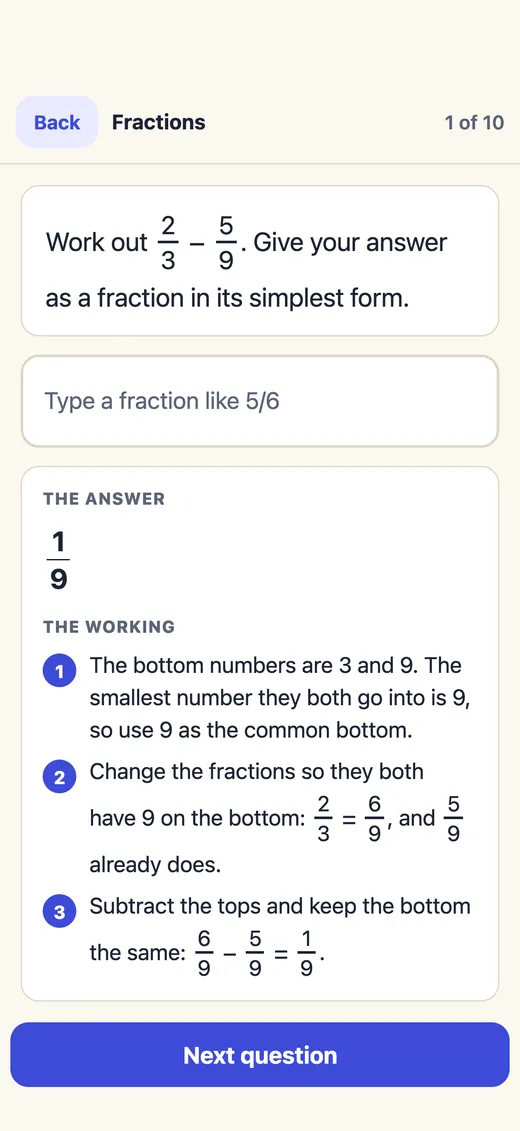
In the app, Fractions, decimals and percentages makes fresh questions every time, so they never run out. Tap Show me one to see a new worked example straight away, or practise ten and open the working whenever you are stuck. Forgotten a method? Type it into Look up and the answer is there.


Coming soon to the App Store
More number topics

The worked answer in Show Working: the answer, then numbered steps in plain words

Show WorkingComing soon to the App Store