

Show Working

NumberFoundation and Higher (some Higher only)

Listing and counting GCSE questions with answers

8 listing and counting questions to try, each with the answer and the full working one tap away. Every question here was made and worked out by the Show Working maths engine, not typed in by hand.

Listing and counting questions ask how many different outcomes there are, such as the two-digit numbers you can make from a few cards. On Higher you use the product rule, multiplying the number of choices at each stage.

Quiz yourself: 8 questions

Worked example 1: listing outcomes

A café menu has 2 starters and 3 main courses, shown below. A meal is one starter and one main course. How many different meals can be chosen?

StartersMain coursesNachosBurgerGarlic breadPastaRisotto
  1. List them in a system, taking each starter in turn.
  2. Nachos with burger, pasta and risotto: 3 meals.
  3. Garlic bread with burger, pasta and risotto: 3 meals.
  4. That is 3 + 3 = 6 meals. (Check: 2 × 3 = 6.)

Answer 6
01 / Quiz yourselfTry it, then tap to check

Listing and counting questions to try

Work each one out on paper first. Then open the answer and compare your working with ours, step by step.

01 / Listing outcomesBoth tiers

A café menu has 2 starters and 3 main courses, shown below. A meal is one starter and one main course. How many different meals can be chosen?

StartersMain coursesSaladFishMelonPiePasta
Show the answer and working
  1. List them in a system, taking each starter in turn.
  2. Salad with fish, pie and pasta: 3 meals.
  3. Melon with fish, pie and pasta: 3 meals.
  4. That is 3 + 3 = 6 meals. (Check: 2 × 3 = 6.)

Answer 6

02 / Listing outcomesBoth tiers

Here are 3 number cards. Two of the cards are put side by side to make a two-digit number, like 13. How many different two-digit numbers can be made?

137
Show the answer and working
  1. List them in a system, taking each card in turn as the first digit.
  2. Starting with 1: 13, 17.
  3. Starting with 3: 31, 37.
  4. Starting with 7: 71, 73.
  5. That is 3 × 2 = 6 numbers.

Answer 6

03 / Listing outcomesBoth tiers

A café menu has 2 starters and 4 main courses, shown below. A meal is one starter and one main course. How many different meals can be chosen?

StartersMain coursesGarlic breadPastaSoupRisottoFishCurry
Show the answer and working
  1. List them in a system, taking each starter in turn.
  2. Garlic bread with pasta, risotto, fish and curry: 4 meals.
  3. Soup with pasta, risotto, fish and curry: 4 meals.
  4. That is 4 + 4 = 8 meals. (Check: 2 × 4 = 8.)

Answer 8

04 / Listing outcomesBoth tiers

Here are 4 number cards. Two of the cards are put side by side to make a two-digit number, like 12. How many different two-digit numbers can be made?

1245
Show the answer and working
  1. List them in a system, taking each card in turn as the first digit.
  2. Starting with 1: 12, 14, 15.
  3. Starting with 2: 21, 24, 25.
  4. Starting with 4: 41, 42, 45.
  5. Starting with 5: 51, 52, 54.
  6. That is 4 × 3 = 12 numbers.

Answer 12

05 / The product rule for countingHigher only

There are 5 players in a chess club. Each player plays every other player once. How many games are played?

Show the answer and working
  1. Each player plays the 4 others: 5 × 4 = 20.
  2. But that counts every game twice (A with B, and B with A), so divide by 2: 20 ÷ 2 = 10.

Answer 10

06 / The product rule for countingHigher only

A shop sells mugs in 6 colours, 5 designs and 4 sizes. A mug has one colour, one design and one size. How many different mugs are possible?

Show the answer and working
  1. For each of the 6 colours there are 5 designs, and for each of those there are 4 sizes.
  2. Multiply the numbers of choices (the product rule): 6 × 5 × 4 = 120.

Answer 120

07 / The product rule for countingHigher only

A restaurant has 5 starters, 7 main courses and 3 desserts. A meal is one of each. How many different meals are possible?

Show the answer and working
  1. For each of the 5 starters there are 7 main courses, and for each of those there are 3 desserts.
  2. Multiply the numbers of choices (the product rule): 5 × 7 × 3 = 105.

Answer 105

08 / The product rule for countingHigher only

A padlock has a 3-digit code. Each digit can be any number from 0 to 9, and digits can repeat. How many different codes are possible?

Show the answer and working
  1. Each of the 3 digits has 10 choices.
  2. Multiply the choices: 10 × 10 × 10 = 1,000.

Answer 1,000

02 / What's covered2 kinds of question

Listing and counting at GCSE and where marks go

  • Listing outcomesBoth tiers
  • The product rule for countingHigher only

Worked example 2: the product rule for counting

A shop sells mugs in 3 colours, 9 designs and 2 sizes. A mug has one colour, one design and one size. How many different mugs are possible?

  1. For each of the 3 colours there are 9 designs, and for each of those there are 2 sizes.
  2. Multiply the numbers of choices (the product rule): 3 × 9 × 2 = 54.

Answer 54

A common mistake

Counting each pair twice when order does not matter. If 5 players each play every other player once, 5 × 4 = 20 counts every game twice, so there are 20 ÷ 2 = 10 games.

03 / Practise itiPhone and iPad

More listing and counting questions in Show Working

In the app, Listing and counting makes fresh questions every time, so they never run out. Tap Show me one to see a new worked example straight away, or practise ten and open the working whenever you are stuck. Forgotten a method? Type it into Look up and the answer is there.

Coming soon to the App Store

More number topics

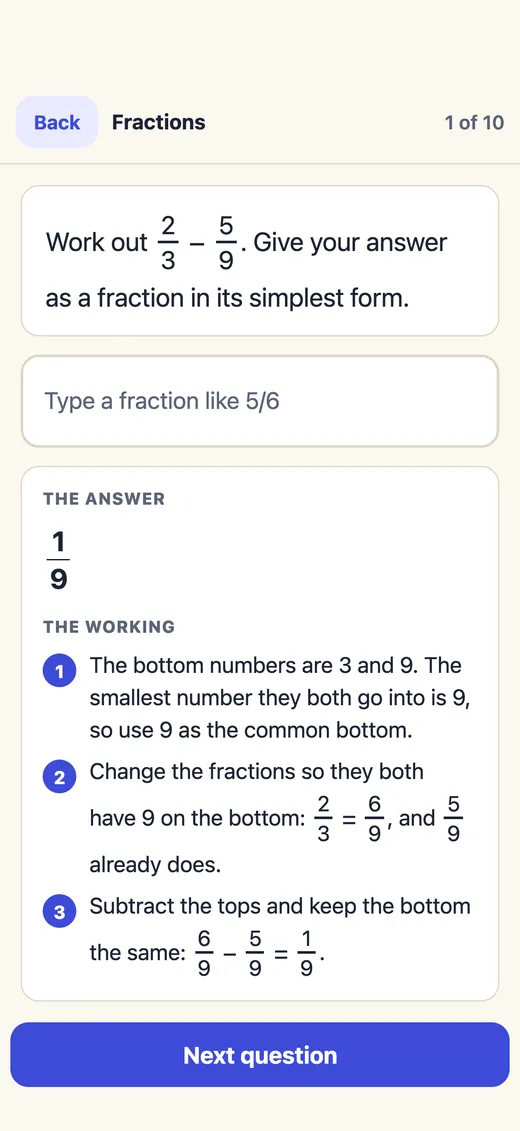
The worked answer in Show Working: the answer, then numbered steps in plain words

Show WorkingComing soon to the App Store