Show Working

NumberHigher

Surds GCSE questions with answers

8 surds questions to try, each with the answer and the full working one tap away. Every question here was made and worked out by the Show Working maths engine, not typed in by hand.

Surds are roots that do not work out to a whole number or fraction, like √2. On Higher you simplify surds, add and multiply them, expand brackets with them and rationalise the denominator so there is no root on the bottom of a fraction.

Quiz yourself: 8 questions

Worked example 1: simplify, add and multiply surds

Simplify √50.

  1. Find the biggest square number that goes into 50. It is 25, because 50 = 25 × 2.
  2. √50 = √25 × √2 = 5√2.

Answer 5√2

01 / Quiz yourselfTry it, then tap to check

Surds questions to try

Work each one out on paper first. Then open the answer and compare your working with ours, step by step.

01 / Simplify, add and multiply surdsHigher only

Simplify √150.

Show the answer and working
  1. Find the biggest square number that goes into 150. It is 25, because 150 = 25 × 6.
  2. √150 = √25 × √6 = 5√6.

Answer 5√6

02 / Simplify, add and multiply surdsHigher only

Simplify √45 + √80. Give your answer as simply as you can.

Show the answer and working
  1. Simplify each surd so they all have √5 in them: √45 = √9 × 5 = 3√5 and √80 = √16 × 5 = 4√5.
  2. Now they are like terms, so collect them, just like 3x + 4x: 3√5 + 4√5 = 7√5.

Answer 7√5

03 / Simplify, add and multiply surdsHigher only

Simplify √300.

Show the answer and working
  1. Find the biggest square number that goes into 300. It is 100, because 300 = 100 × 3.
  2. √300 = √100 × √3 = 10√3.

Answer 10√3

04 / Simplify, add and multiply surdsHigher only

Simplify √112 − √7. Give your answer as simply as you can.

Show the answer and working
  1. Simplify each surd so they all have √7 in them: √112 = √16 × 7 = 4√7.
  2. Now they are like terms, so collect them, just like 4x − x: 4√7 − √7 = 3√7.

Answer 3√7

05 / Rationalise the denominator and expand surdsHigher only

Expand and simplify (5 + √2)(6 + √2).

Show the answer and working
  1. Multiply each term in the first bracket by each term in the second bracket.
  2. 5 × 6 = 30, 5 × √2 = 5√2, √2 × 6 = 6√2, and √2 × √2 = 2, because √2 × √2 = 2.
  3. Collect the whole numbers: 30 + 2 = 32. Collect the surds: 5√2 + 6√2 = 11√2.
  4. So the answer is 32 + 11√2.

Answer 32 + 11√2

06 / Rationalise the denominator and expand surdsHigher only

Rationalise the denominator of 10√10. Give your answer as simply as you can.

Show the answer and working
  1. Multiply the top and the bottom by √10. This does not change the value, because √10√10 = 1.
  2. Top: 10 × √10 = 10√10. Bottom: √10 × √10 = 10.
  3. So 10√10 = 10√1010, which simplifies to √10.

Answer √10

07 / Rationalise the denominator and expand surdsHigher only

Rationalise the denominator of 13√3. Give your answer as simply as you can.

Show the answer and working
  1. Multiply the top and the bottom by √3. This does not change the value, because √3√3 = 1.
  2. Top: 13 × √3 = 13√3. Bottom: √3 × √3 = 3.
  3. So 13√3 = 13√33.

Answer 13√33

08 / Rationalise the denominator and expand surdsHigher only

Expand and simplify (2 + 3√3)(2 − 3√3).

Show the answer and working
  1. Multiply each term in the first bracket by each term in the second bracket.
  2. 2 × 2 = 4, 2 × (−3√3) = −6√3, 3√3 × 2 = 6√3, and 3√3 × (−3√3) = −27, because √3 × √3 = 3.
  3. Collect the whole numbers: 4 − 27 = −23. The surds cancel out: −6√3 + 6√3 = 0.
  4. So the answer is −23.

Answer −23

02 / What's covered2 kinds of question

Surds at GCSE and where marks go

  • Simplify, add and multiply surdsHigher only
  • Rationalise the denominator and expand surdsHigher only

Worked example 2: rationalise the denominator and expand surds

Rationalise the denominator of 24√10. Give your answer as simply as you can.

  1. Multiply the top and the bottom by √10. This does not change the value, because √10√10 = 1.
  2. Top: 2 × √10 = 2√10. Bottom: 4√10 × √10 = 40, because √10 × √10 = 10.
  3. So 24√10 = 2√1040, which simplifies to √1020.

Answer √1020

A common mistake

Adding the numbers under the roots. √2 + √8 is not √10. Simplify first: √8 = √4 × √2 = 2√2, so √2 + √8 = 3√2.

03 / Practise itiPhone and iPad

More surds questions in Show Working

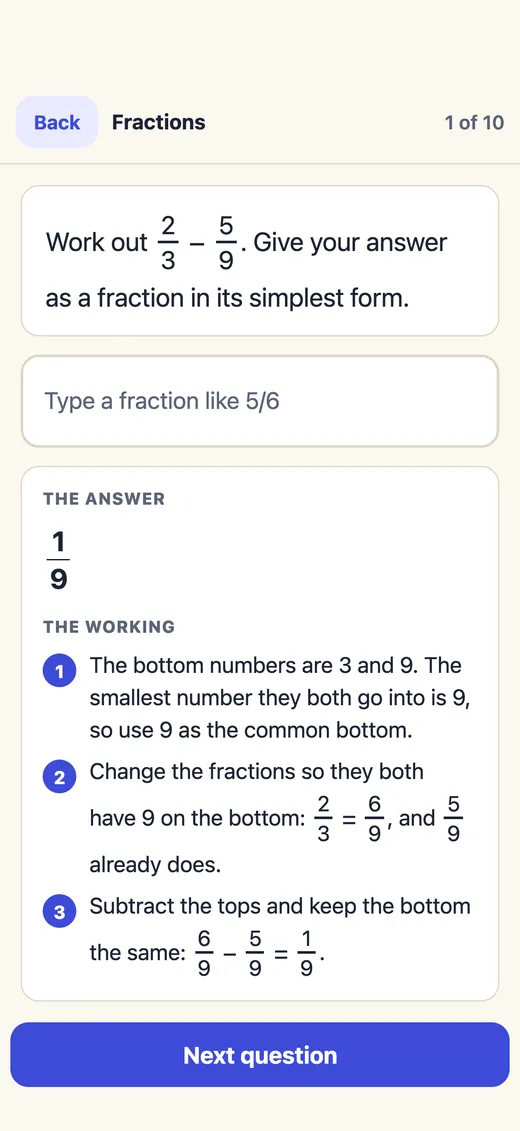
In the app, Surds makes fresh questions every time, so they never run out. Tap Show me one to see a new worked example straight away, or practise ten and open the working whenever you are stuck. Forgotten a method? Type it into Look up and the answer is there.


Coming soon to the App Store
More number topics

The worked answer in Show Working: the answer, then numbered steps in plain words

Show WorkingComing soon to the App Store