

Show Working
Open the app

GCSE BusinessEvery exam board

Break-even: the formula, the chart and margin of safety

A business breaks even when its total revenue equals its total costs, so it makes no profit and no loss. Sell more than that and it makes a profit. Sell less and it makes a loss.

Break-even output = fixed costs ÷ (selling price per unit − variable cost per unit)

A cupcake stall has fixed costs of £1,300 a month, charges £3.25 a cupcake and each one costs £1 to make. Each sale contributes £2.25, and £1,300 ÷ £2.25 = 577.8, so it needs to sell 578 cupcakes a month to break even.

The rules Quiz yourself: 8 questions

Worked example: break-even output

Grace runs a bike repair shop. Its fixed costs are £4,100 a month. It charges £43.50 for each repair, and the variable cost of each one is £14.10. Work out the break-even output for a month. Give your answer as a whole number of units.

  1. Break-even output = fixed costs ÷ contribution per unit, where contribution per unit = selling price − variable cost per unit.
  2. Contribution per unit = £43.50 − £14.10 = £29.40.
  3. Break-even output = £4,100 ÷ £29.40 = 139.46….
  4. Round up to 140: at 139 units the business would still make a small loss.
  5. Break-even output = 140 units. Write "units" with the answer.

Answer 140 units
01 / The rulesLearn these

The rules for break-even

Contribution per unit

Selling price minus variable cost per unit. It is what each sale puts towards the fixed costs, and the bottom half of the break-even formula.

Edexcel, OCR and Eduqas

Answer in units

Break-even output is a number of products, so write "units" (or cupcakes, repairs). If it is not a whole number, round up: selling part of one does not cover the costs.

Edexcel, OCR and Eduqas

Break-even revenue

Break-even output × selling price. It is the sales in pounds needed to break even.

Edexcel

Margin of safety

Actual or planned sales minus break-even output. It shows how far sales could fall before the business makes a loss. Give it in units.

Every board

Working back

Fixed costs = break-even output × contribution per unit. Rearrange the same way to find a price or a variable cost.

Edexcel, OCR and Eduqas

What moves it

A higher price or lower variable costs lower the break-even point. Higher fixed costs raise it.

Every board

Reading a break-even chart

  • The fixed costs line is flat: they stay the same whatever the output.
  • The total costs line starts at the fixed costs and rises with output.
  • The revenue line starts at zero, because no sales means no money in.
  • Where revenue crosses total costs is the break-even point. Read down to the output axis for break-even output.
  • To the right of that point, the gap between revenue and total costs is profit. To the left it is loss.

Worth knowing

Mark schemes lose marks most often for a missing unit, for using the selling price instead of the contribution, and for mixing up fixed and variable costs. Fixed costs, like rent, do not change with output. Variable costs, like ingredients, do.

02 / Quiz yourselfTry it, then tap to check

Break-even questions to try

Work each one out on paper first, then open the answer and compare your working with ours. Every question here was made and checked by the Show Working app.

01 / Break-even outputEdexcel, OCR, Eduqas

Grace runs a bike repair shop. Its fixed costs are £4,100 a month. It charges £43.50 for each repair, and the variable cost of each one is £14.10. Work out the break-even output for a month. Give your answer as a whole number of units.

Show the answer and working
  1. Break-even output = fixed costs ÷ contribution per unit, where contribution per unit = selling price − variable cost per unit.
  2. Contribution per unit = £43.50 − £14.10 = £29.40.
  3. Break-even output = £4,100 ÷ £29.40 = 139.46….
  4. Round up to 140: at 139 units the business would still make a small loss.
  5. Break-even output = 140 units. Write "units" with the answer.

Answer 140 units

02 / Break-even outputEdexcel, OCR, Eduqas

Ellie runs a small bakery. Its fixed costs are £3,300 a month. It charges £4.10 for each loaf. The variable costs of each one are £0.10 for materials and £1.15 for packaging. Work out the break-even output for a month. Give your answer as a whole number of units.

Show the answer and working
  1. Break-even output = fixed costs ÷ contribution per unit, where contribution per unit = selling price − variable cost per unit.
  2. Variable cost per unit = £0.10 + £1.15 = £1.25, so contribution per unit = £4.10 − £1.25 = £2.85.
  3. Break-even output = £3,300 ÷ £2.85 = 1157.89….
  4. Round up to 1,158: at 1,157 units the business would still make a small loss.
  5. Break-even output = 1,158 units. Write "units" with the answer.

Answer 1,158 units

03 / Working back from break-evenEdexcel, OCR, Eduqas

Grace runs a bike repair shop. Its break-even output is 260 repairs a month. Its fixed costs are £7,644 a month, and the variable cost of each repair is £14.10. What price does it charge for each repair?

Show the answer and working
  1. Break-even output = fixed costs ÷ contribution per unit, so contribution per unit = fixed costs ÷ break-even output.
  2. Contribution per unit = £7,644 ÷ 260 = £29.40.
  3. Contribution = price − variable cost, so price = £29.40 + £14.10 = £43.50.

Answer £43.50

04 / Working back from break-evenEdexcel, OCR, Eduqas

Mei runs a pizza takeaway. Its break-even output is 2,600 pizzas a month. It charges £8.30 for each pizza, and the variable cost of each one is £4.80. Work out its fixed costs for a month.

Show the answer and working
  1. Break-even output = fixed costs ÷ contribution per unit, so fixed costs = break-even output × contribution per unit.
  2. Contribution per unit = £8.30 − £4.80 = £3.50.
  3. Fixed costs = 2,600 × £3.50 = £9,100.

Answer £9,100

05 / Break-even revenueEdexcel

Grace runs a bike repair shop. Its fixed costs are £7,644 a month. It charges £43.50 for each repair, and the variable cost of each one is £14.10. Work out its break-even revenue for a month.

Show the answer and working
  1. Break-even revenue = break-even output × selling price. Find the break-even output first.
  2. Contribution per unit = £43.50 − £14.10 = £29.40, so break-even output = £7,644 ÷ £29.40 = 260 units.
  3. Break-even revenue = 260 × £43.50 = £11,310.

Answer £11,310

06 / Break-even revenueEdexcel

Mei runs a pizza takeaway. Its fixed costs are £9,100 a month. It charges £8.30 for each pizza, and the variable cost of each one is £4.80. Work out its break-even revenue for a month.

Show the answer and working
  1. Break-even revenue = break-even output × selling price. Find the break-even output first.
  2. Contribution per unit = £8.30 − £4.80 = £3.50, so break-even output = £9,100 ÷ £3.50 = 2,600 units.
  3. Break-even revenue = 2,600 × £8.30 = £21,580.

Answer £21,580

07 / Margin of safetyEvery board

Grace runs a bike repair shop. Its break-even output is 220 repairs a month. It expects to sell 290 repairs next month. Work out the margin of safety.

Show the answer and working
  1. Margin of safety = actual (or planned) sales − break-even output.
  2. Break-even output = 220 units (given).
  3. Margin of safety = 290 − 220 = 70 units.

Answer 70 units

08 / Margin of safetyEvery board

The break-even chart is for a pizza takeaway run by Hannah. The business plans to sell 810 pizzas next month. Use the chart to find the margin of safety.

04008001,2001,6002,00005,00010,00015,00020,00025,00030,000Output (units)Costs and revenue (£)Total revenueTotal costsFixed costs
Show the answer and working
  1. Margin of safety = actual (or planned) sales − break-even output.
  2. Break-even is where the total revenue line crosses the total costs line: at 600 units.
  3. Margin of safety = 810 − 600 = 210 units.

Answer 210 units

03 / By exam boardNot affiliated with any board

Break-even on each exam board

AQA (8132)Reads break-even output and the margin of safety off a chart. AQA pupils do not draw the chart or use the formula.
Edexcel (1BS0)The formula, break-even revenue, the margin of safety and reading a chart.
OCR (J204)A simple break-even calculation and reading a chart.
EduqasThe formula with contribution, and drawing and reading a break-even chart.

Show Working is not affiliated with AQA, Edexcel (Pearson), OCR or WJEC Eduqas. Check your own board's specification for the exact wording.

04 / QuestionsGCSE Business

Break-even, answered

What is the break-even formula?

Break-even output = fixed costs ÷ (selling price per unit − variable cost per unit). The bottom part, price minus variable cost, is called the contribution per unit.

What is contribution in business?

Contribution per unit is the selling price minus the variable cost of one unit. It is the amount each sale puts towards paying the fixed costs, and once those are paid, towards profit.

How do you work out the margin of safety?

Take the break-even output away from the actual or planned sales. If a business breaks even at 220 units and expects to sell 290, its margin of safety is 70 units.

How do you find break-even on a chart?

Find where the total revenue line crosses the total costs line. That point is break-even. Read straight down to the output axis for the break-even output.

Do all exam boards use the break-even formula?

No. Edexcel, OCR and Eduqas use it. AQA pupils read break-even output and the margin of safety off a chart instead of calculating it.

05 / Practise itiPhone, iPad and the web

More break-even questions in Show Working

The app makes fresh break-even questions every time, so they never run out. Get one wrong and you see every step of the working.

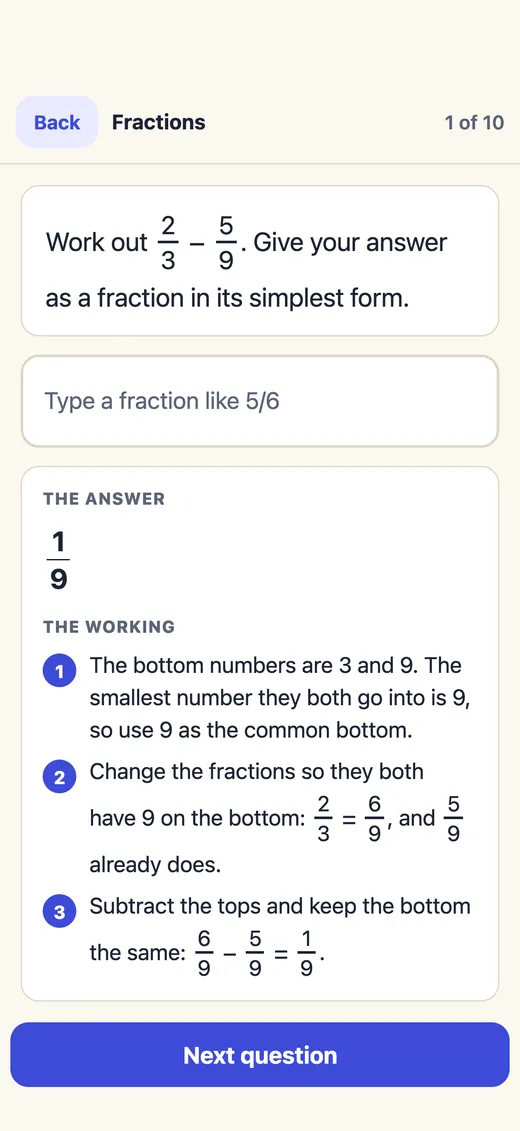
The worked answer in Show Working: the answer, then numbered steps in plain words

Show WorkingFree on the App StoreFree in your browser, no download

Open it free