 Show Working


Revision guideEngland, 2026 to 2027
How many GCSEs do you need?
There's no single number everyone needs. Sixth forms and colleges usually ask for about five GCSEs at grade 4 or above for A levels and other level 3 courses, including English and maths. Universities mostly ask about your English and maths grades, not how many GCSEs you have.
Each school, college, university and employer sets its own entry rules, so the numbers on this page are what's usual, not a law. Always check the course or job you want.
In short.
Most 16-year-olds take 7 to 10 GCSEs, and 8 on average (summer 2026).
About five at grade 4 or above usually opens sixth form and college level 3 courses, including A levels and T Levels.
English and maths matter most. Without a grade 4 in them, you keep studying them after 16.
You can take more GCSEs, or resit them, at any age.
01 / After GCSEsWhat each route usually asks for
How many GCSEs you need for each route
This is what's typical in England. Courses at the same level can ask for different grades, so treat it as a starting point and read the entry rules for each course you apply to.
| Route | What you usually need | Good to know |
|---|---|---|
| A levels at sixth form or college | About five GCSEs at grade 4 or above, often with some at grade 5, including English and maths | Some ask for a 6 in a subject you want to take at A level, like maths. |
| T Levels | Often five GCSEs at grade 4 or above, including English and maths | Schools and colleges set their own rules. A one-year T Level Foundation Year can help you get ready. |
| Other level 3 college courses | Often four or five GCSEs at grade 4 or above, with English or maths among them | Level 3 is the same level as A levels. |
| Level 2 college courses | Often about four GCSEs at grade 3 or above | A level 2 course can lead on to level 3 the year after. |
| Level 1 and entry level courses | Often no set GCSE grades | Colleges still expect basic reading, writing and maths. |
| Foundation apprenticeship (level 2) | No set grades or qualifications | For ages 16 to 21, and some 22 to 24 year olds. |
| Other apprenticeships (levels 2 to 7) | Set by each employer. Some ask for GCSE English or maths | The advert lists the entry rules. If you're 16 to 18, you must reach level 2 English and maths to finish. |
| University | No set number. Most courses ask for English and maths at grade 4 or above | Some courses ask for higher grades or other subjects, such as a 6 or 7 in maths. |
| Jobs | Set by each employer | Where a job used to ask for a C, a 4 is the grade to aim for now. |
Sixth form and college rows are typical figures from colleges' own entry pages, read in November 2026, such as Runshaw College, Bolton Sixth Form College and Wirral Metropolitan College. They're examples, not a national rule. Other rows: T Levels website, the Department for Education's Skills for Careers site, gov.uk and UCAS.
02 / Sixth form and collegeA levels, T Levels and more
How many GCSEs do you need for sixth form?
For A levels, it's usually about five GCSEs at grade 4 or above, and some sixth forms ask for grade 5s. Here's what three colleges list on their own entry pages, to give you an idea.
- Runshaw College, A levels5 GCSEs at grade 5, with English and maths at grade 4 or above
- Bolton Sixth Form College, three A levels5 GCSEs: two at grade 5 and three at grade 4, including English language and maths. A level maths also needs a 6 in GCSE maths
- Wirral Metropolitan College, T Levels5 GCSEs at grade 4 or above, including English language and maths
Read from each college's own entry page in November 2026. Some sixth forms ask for more, so check yours.
Grades matter more than the count
A sixth form is more likely to look at your grades in English, maths and the subjects you want to study than at whether you have 8 GCSEs or 10. Taking an extra GCSE won't make up for a low grade in a subject the course needs.
If you don't get the grades
Many colleges run courses at several levels, so if you miss the grades for level 3, you may be able to start at level 2 and move up after a year. Talk to the college before results day, and again on the day if your grades are different from what you expected.
03 / UniversityDegrees and UCAS
How many GCSEs do you need for university?
There's usually no set number. Universities mostly ask for GCSE English and maths at grade 4 or above, and your A levels or other level 3 results decide most offers.
- English and maths at grade 4 is the most common GCSE requirement on university courses.
- Some courses ask for more. Some maths degrees ask for a 7 in GCSE maths, and some courses, such as medicine, name science grades too.
- GCSEs don't earn UCAS points. UCAS Tariff points are only for level 3 qualifications, like A levels.
- Your whole set of GCSEs can still count. The University of Bath, for example, says there's no set number of GCSEs, most of its applicants have about eight, and many of its courses look at your best eight grades.
- English literature may not count for English. Some courses only accept English language, so check.
Sources: UCAS Tariff calculator, course listings on UCAS, and the University of Bath's UK qualification guidance. Search for your course on UCAS to see its exact GCSE grades.
04 / Apprenticeships and jobsWorking and training
Do you need GCSEs for an apprenticeship or a job?
Not always. To start an apprenticeship, you need to be 16 or over, live in England and not be in full-time education. Any grades on top of that are up to the employer.
- Foundation apprenticeship (level 2)No set grades or qualifications. For ages 16 to 21, and some 22 to 24 year olds
- Intermediate (level 2)The same level as GCSEs
- Advanced (level 3)The same level as A levels
- Higher (level 4 and up) and degree (levels 6 and 7)From foundation degree level up to a bachelor's or master's degree
- The advert lists the entry rules. Some apprenticeships ask for GCSE English or maths, and others teach you the English and maths you need.
- 16 to 18 at the start? You must reach level 2 in English and maths to finish the apprenticeship, unless you already have them. A GCSE at grade 4 or above is level 2.
- Jobs set their own rules. Each employer decides which GCSEs it wants. The Department for Education says that where an employer used to ask for a C, asking for a 4 is reasonable.
- Some careers need set grades later on. Teacher training, for example, needs English and maths GCSEs at grade 4 or above, and science too to teach primary.
Sources: gov.uk, "Become an apprentice" and "What qualification levels mean"; the Department for Education's Skills for Careers site; "English and maths requirements in apprenticeships guidance" (updated 19 February 2026); gov.uk, "Apply for teacher training".
05 / How many people takeSummer 2026, England
How many GCSEs do most pupils take?
- 8 on average for 16-year-olds in England in summer 2026.
- 9 was the most common number, taken by 28.4% of 16-year-olds, then 8 (25.8%), 7 (16.1%) and 10 (10.9%). About four in five took between 7 and 10.
- Combined science counts as two GCSEs, because you get two grades for it.
- English, maths and science are compulsory to study in years 10 and 11, so nearly everyone takes GCSEs in them. Your options make up the rest.
Source: Ofqual, "Qualification results in England: summer 2026". Extra GCSEs aren't usually what counts: sixth forms, universities and employers look at your grades in the subjects they need.
06 / English and mathsThe 16 to 18 rule
What if you don't get a 4 in English or maths?
You keep studying it after 16. If you're 16 to 18 on a sixth form or college course and you don't have grade 4 in English or maths, you carry on with that subject alongside your main course.
- Grade 3, full time: you study for the GCSE again and resit it.
- Grade 2 or below: you can work towards Functional Skills level 2 or the GCSE, sometimes starting with a level 1 course.
- English language or literature: a grade 4 in either one counts for English.
- The rule is for English and maths only. It doesn't apply to any other subject.
- Everyone stays in learning until 18. In England that means full-time study, an apprenticeship, or 20 hours or more a week of work or volunteering with part-time study.
Source: Department for Education, "2026 to 2027 academic year: 16 to 19 funding: maths and English condition of funding" (updated 24 July 2026), and gov.uk, "Know when you can leave school".
07 / Later onExtra GCSEs and resits
Can you take extra GCSEs or resit later?
Yes. You can take a GCSE at any age, as many times as you like. If you've left school, you enter as a private candidate through an exam centre, and the centre charges a fee.
- Every subject in the summer. The summer 2027 exams start on 10 May 2027, and entries close on 21 February 2027.
- English language and maths in November too, if you're 16 or older on 31 August that year.
- Free English and maths for adults. If you're 19 or over and don't have a grade 4, you can usually get a free course in English or maths. It pays for the course, not just the exam.
08 / Practise16 subjects
Get the grades your next step asks for
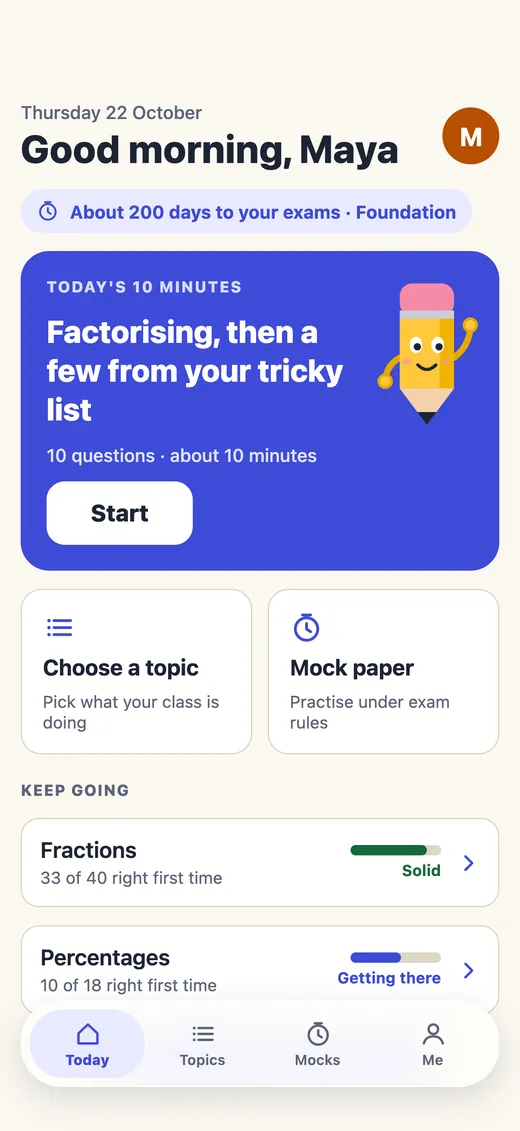
Show Working has questions for 16 GCSE subjects, English and maths included, marked straight away with the working or the reason for every answer. Pick your exam board and tier and you only see what your exam asks for.
On a computer? Use it free in your browser
09 / QuestionsAll questions
How many GCSEs, answered
How many GCSEs do you need?
There's no single number everyone needs. Sixth forms and colleges usually ask for about five GCSEs at grade 4 or above for A levels and other level 3 courses, including English and maths. Universities mostly ask about your English and maths grades, not how many GCSEs you have.
How many GCSEs do you need for sixth form?
For A levels, usually about five GCSEs at grade 4 or above, including English and maths, and some sixth forms ask for grade 5s. Some also ask for a 6 in a subject you want to study, like maths. Each sixth form sets its own rules, so check the ones you're applying to.
How many GCSEs do you need for university?
There's usually no set number. Most courses ask for GCSE English and maths at grade 4 or above, and some ask for higher grades or other subjects. GCSEs don't earn UCAS points, which are only for level 3 qualifications like A levels.
Do you need GCSEs for an apprenticeship?
Not always. A foundation apprenticeship needs no set grades. For other apprenticeships, the employer sets the entry rules and lists them in the advert, and some ask for GCSE English or maths. If you're 16 to 18, you must reach level 2 English and maths to finish.
What happens if you don't get a 4 in English or maths?
You keep studying it after 16. If you're 16 to 18 at sixth form or college without grade 4 in English or maths, you carry on with that subject alongside your main course. With a grade 3 on a full-time course, you study for the GCSE again. The rule doesn't apply to other subjects.
Can you take more GCSEs later?
Yes. You can take a GCSE at any age, as many times as you like, as a private candidate through an exam centre, which charges a fee. If you are 19 or over without grade 4 in English or maths, you can usually get a free course in them.
More revision guides
Sources
Ofqual, Qualification results in England: summer 2026. Department for Education, maths and English condition of funding 2026 to 2027. gov.uk, What qualification levels mean, Become an apprentice, Know when you can leave school and Apply for teacher training. Department for Education, Skills for Careers: apprenticeships and English and maths requirements in apprenticeships. T Levels: resources for parents. UCAS, Tariff calculator. University of Bath, UK qualification guidance. College examples: Runshaw College, Bolton Sixth Form College, Wirral Metropolitan College. All read on 18 November 2026. Show Working isn't linked to any exam board, college or university.
Grades open doors.
Practise for the grades you need.
Fresh questions with the working shown. The first topic of every subject is free.
On a computer? Use it free in your browser