 Show Working


Revision guideEngland, 2026 to 2027
GCSE grades, explained
GCSEs in England are graded from 9 to 1, and 9 is the top grade. A grade 4 is a standard pass and lines up with the bottom of an old grade C. A grade 7 lines up with the bottom of an old A, and a 5 is called a strong pass.
If you don't get enough marks for a grade 1, you get a U. The numbers replaced the old A* to G letters, starting with English and maths in 2017.
01 / Numbers and lettersOfqual and the Department for Education
GCSE numbers to old letters
The two scales don't match one to one. Only three points line up exactly: the bottom of a 7 with the bottom of an A, the bottom of a 4 with the bottom of a C, and the bottom of a 1 with the bottom of a G. The rest is a rough guide.
| Grade | Old letter, roughly | What it means |
|---|---|---|
| 9 | A*, the very top | The highest grade. Fewer pupils get a 9 than used to get an A*. |
| 8 | A* | A very high grade. |
| 7 | A | The bottom of a 7 is the bottom of an old A. |
| 6 | B | A high B. |
| 5 | Low B or high C | A strong pass. |
| 4 | C | A standard pass. The bottom of a 4 is the bottom of an old C. |
| 3 | D or E | Below a pass. |
| 2 | E or F | Below a pass. |
| 1 | F or G | The lowest grade. The bottom of a 1 is the bottom of an old G. |
| U | U | Unclassified: not enough marks for a grade. |
Sources: Ofqual, "GCSE 9 to 1 grade scale explained" (June 2025) and its "Grading new GCSEs" chart, and the Department for Education's GCSE factsheets (May 2019).
02 / Each gradeWhat a 4, 5, 6 or 7 means
What each GCSE grade means
- Grade 4 is a standard pass. The Department for Education counts grade 4 and above as a standard pass in every subject. If a college or job used to ask for a C, a 4 is the grade to aim for now.
- Grade 5 is a strong pass. The Department for Education uses grade 5 in English and maths as a strong pass in its school performance measures. Sixth forms, colleges and employers set their own entry grades, so check the ones you're applying to.
- Grade 6 is roughly a high B. It sits between a strong pass and the old A.
- Grade 7 is roughly an A. Grades 7, 8 and 9 cover what used to be A and A*, so there are more grades at the top than before.
- Grade 9 is higher than an old A*. It goes to fewer pupils than A* did.
- Below a 4 in English or maths means you keep studying that subject after 16, at sixth form or college. That rule doesn't apply to other subjects.
Combined science gets two grades
Combined science counts as two GCSEs, so you get a double grade, like 6-6 or 6-5. The two numbers are always the same or next to each other.
In summer 2026, 67.3% of GCSE results across England, Wales and Northern Ireland were grade 4 (or C) or above, and 22% were grade 7 (or A) or above. Source: JCQ, GCSE results press notice, 20 August 2026.
03 / TiersFoundation and Higher
Which grades each tier can get
Some subjects, like maths, the sciences and languages, have two tiers. You sit one or the other, and each tier has its own range of grades.
- Foundation tierGrades 1 to 5 (1-1 to 5-5 in combined science)
- Higher tierGrades 4 to 9 (4-4 to 9-9 in combined science)
- Just miss a 4 on HigherYou may be given a grade 3 (4-3 in combined science). Below that, it's a U.
Source: Ofqual, student guide to exams and assessments in 2026. A grade is the same grade whichever tier it came from.
04 / MarksGrade boundaries
How many marks you need for a grade
There's no fixed number. The marks you need for each grade are called grade boundaries, and the exam boards set them after the papers have been marked.
- They change every year. If a paper is harder than usual, the boundaries can be lower, so a grade is no easier or harder to get from one year to the next.
- There are no quotas. Ofqual says there's no limit on how many pupils can get each grade.
- Each subject, tier and board has its own. A grade 5 in AQA maths and a grade 5 in Pearson Edexcel maths can need different marks.
- They come out on results day. AQA, for example, publishes them at 8am on results day.
Why a percentage doesn't tell you a grade
Boundaries are set in marks, papers have different totals, and the boundaries move every year. So a score like 70% can be one grade in one subject and a different grade in another. To see what last year's papers needed, look at the boards' own grade boundary pages.
Show Working isn't linked to any exam board. These links go to the boards' own sites.
05 / New grades2017 to 2020
When the new GCSE grades came in
- 2017English language, English literature and maths, the first exams graded 9 to 1
- 201820 more subjects, including the sciences, history, geography, French and Spanish
- 201925 more, including business, psychology, sociology and statistics
- 2020The last few languages. From 2020, certificates show only number grades.
Source: Department for Education, GCSE factsheet for parents (May 2019). Old letter grades are still valid for jobs and further study.
Wales and Northern Ireland
This guide is about GCSEs in England. Wales and Northern Ireland have their own GCSE grading scales, so a GCSE taken there can look different. Qualifications Wales and CCEA explain their own grades.
06 / Practise16 subjects
Move up a grade, ten minutes at a time
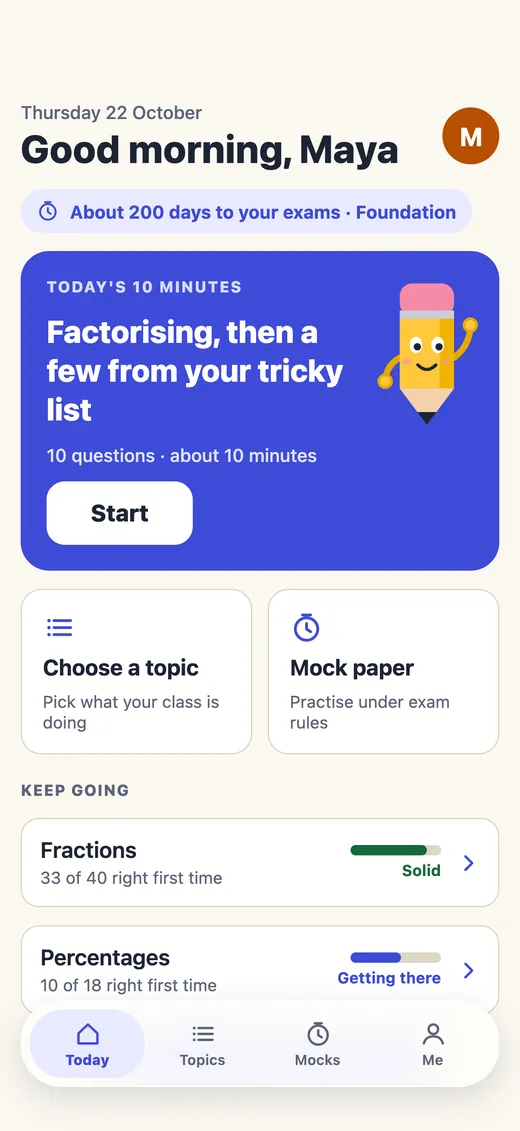
Show Working has questions for 16 GCSE subjects, marked straight away, with the working or the reason for every answer. Pick your exam board and tier and you only see what your exam asks for.
On a computer? Use it free in your browser
07 / QuestionsAll questions
GCSE grades, answered
What do GCSE grades 9 to 1 mean?
GCSEs in England are graded from 9 to 1, and 9 is the top grade. A grade 4 is a standard pass and lines up with the bottom of an old grade C. A grade 7 lines up with the bottom of an old A, and a 5 is called a strong pass.
What is a grade 4 equivalent to in old GCSE grades?
A grade 4 is roughly a C: the bottom of a 4 is the bottom of an old C. The Department for Education counts grade 4 and above as a standard pass in every subject. If a college or job used to ask for a C, a 4 is the grade to aim for now.
What is a 5 in GCSE?
A grade 5 is roughly a low B or high C in old letter grades. The Department for Education uses grade 5 in English and maths as a strong pass in its school performance measures.
What is a 6 in GCSE?
Grade 6 is roughly a high B. It sits between a strong pass and the old A.
What is a grade 7 equivalent to?
Grade 7 is roughly an A. The bottom of a 7 is the bottom of an old A, and grades 7, 8 and 9 cover what used to be A and A*.
What percentage do you need for each GCSE grade?
There's no fixed number. The marks you need for each grade are called grade boundaries, and the exam boards set them after the papers have been marked. Boundaries are set in marks, papers have different totals, and the boundaries move every year.
More revision guides
Every mark counts.
Find the marks that move your grade.
Fresh questions with the working shown. The first topic of every subject is free.
On a computer? Use it free in your browser