Show Working
Open the app

Revision guideQuestions worth 3 to 5 marks

GCSE maths exam questions, with the marks shown

Most marks on a GCSE maths paper come from questions worth 3, 4 or 5 marks, where you join several steps together. Here are 52 kinds of them in the app, and 12 to try on this page, each with the answer, the working and how every mark is given.

Every answer and every mark line is worked out by the app's own maths engine. Our own questions, not past paper questions.

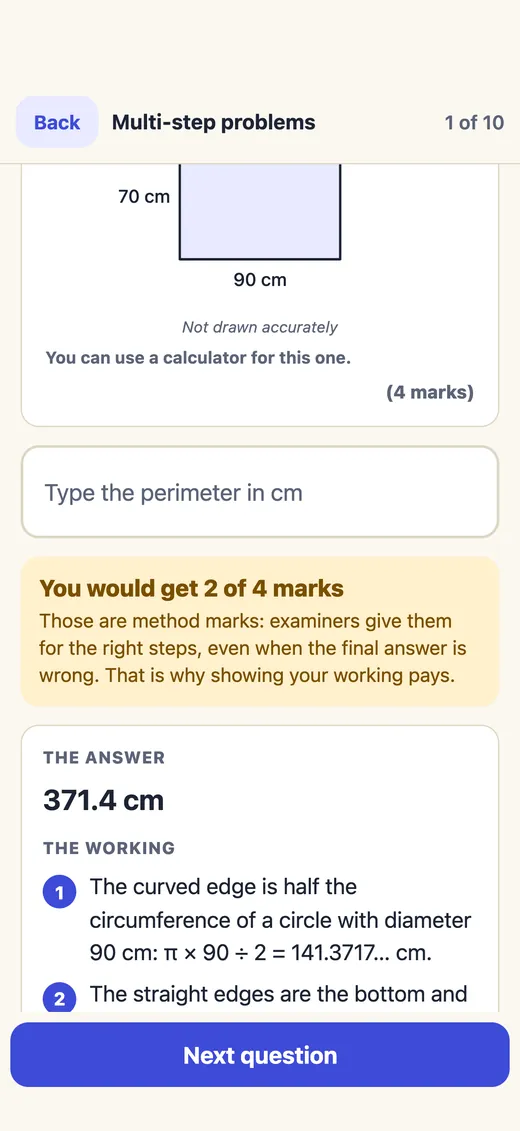
A 4-mark question in Show Working after Mark my method: You would get 2 of 4 marks, then the working and how the marks are given

01 / How the marks workIn plain words

Most of the marks are for the method

  • Method marks are for a right step on the way, like finding the area before working out the paint. You keep them even if a later step goes wrong.
  • Accuracy marks are for a right value that comes from a right method, often the final answer.
  • Some marks stand on their own, for a fact or a value that does not need a method, like the angles in a triangle adding to 180°.
  • A right answer with no working can still score full marks, unless the question says "show your working". A wrong answer with no working scores nothing.

That is why we called the app Show Working. Read more in what "show your working" means.

02 / Try theseEasier first, Higher ones at the end

12 exam-style questions, with the marks

Work each one out on paper first. Then open it to check the answer, every step of the working, and which line earns which mark.

01 / Ratio3 marks · Both tiers

A shop sells bags of crisps in two packs.
Pack A: 4 bags of crisps for £0.80
Pack B: 15 bags of crisps for £3.60
Which pack is better value? Work out how much less one bag costs in the better pack. Give your answer in pence.

(3 marks)

Show the answer, working and marks
  1. Pack A: 80 ÷ 4 = 20, so one bag costs 20p.
  2. Pack B: 360 ÷ 15 = 24, so one bag costs 24p.
  3. Pack A is better value, because each bag costs less. The difference is 24 − 20 = 4p.

Answer 4p

How the 3 marks are given

1 markThe cost of one bag in Pack A: 20p

1 markThe cost of one bag in Pack B: 24p

1 markThe difference: 4p

02 / Ratio3 marks · Both tiers

Grace and Femi share the money they made washing cars in the ratio 2 : 3.
Femi gets £6 more than Grace.
Work out the total amount of money they share.

(3 marks)

Show the answer, working and marks
  1. Grace gets 2 parts and Femi gets 3 parts, so the difference is 3 − 2 = 1 part.
  2. So one part is worth £6.
  3. There are 2 + 3 = 5 parts altogether: 5 × 6 = 30, so they share £30.
  4. Check: Grace gets 2 × 6 = 12 and Femi gets 3 × 6 = 18. The difference is 18 − 12 = 6, as it should be.

Answer £30

How the 3 marks are given

1 markSeeing the difference is 1 part and finding one part: £6

1 markMultiplying one part by the 5 parts altogether (or finding both shares, £12 and £18)

1 markThe total: £30

03 / Geometry4 marks · Both tiers

Amir is painting a wall that is 9 m wide and 2.4 m high.
The wall has a door in it that is 2 m high and 0.8 m wide. The door is not painted.
The wall needs two coats of paint. One litre of paint covers 12 m².
Paint is sold in 2.5 litre tins that cost £12.99 each.
Work out how much Amir spends on paint.

(4 marks)

Show the answer, working and marks
  1. Area of the wall: 9 × 2.4 = 21.6 m². Take away the door, 2 × 0.8 = 1.6 m²: 21.6 − 1.6 = 20 m².
  2. Two coats means painting 2 × 20 = 40 m².
  3. Litres needed: 40 ÷ 12 = about 3.33 litres.
  4. Each tin holds 2.5 litres, so 3.33 ÷ 2.5 is about 1.33 tins. You cannot buy part of a tin, so round up to 2 tins.
  5. Cost: 2 × 12.99 = £25.98.

Answer £25.98

How the 4 marks are given

1 markThe area to paint, taking away the door: 20 m²

1 markUsing two coats and 12 m² a litre to find the paint needed: about 3.33 litres

1 markRounding up to whole tins: 2 tins

1 markThe cost: £25.98

04 / Geometry4 marks · Both tiers

The diagram shows a window made from a rectangle and a semicircle. The diameter of the semicircle is the top of the rectangle.
Work out the perimeter of the window. Give your answer to 1 decimal place.

110 cm140 cm
Not drawn accurately

You can use a calculator for this one.

(4 marks)

Show the answer, working and marks
  1. The curved edge is half the circumference of a circle with diameter 110 cm: π × 110 ÷ 2 = 172.7876… cm.
  2. The straight edges are the bottom and the two sides: 110 + 140 + 140 = 390 cm. The dashed line is inside the shape, so it is not counted.
  3. Perimeter: 172.7876… + 390 = 562.7876… cm.
  4. To 1 decimal place: 562.8 cm.

Answer 562.8 cm

How the 4 marks are given

1 markThe length of the curve: 172.8 cm

1 markThe straight edges: 390 cm

1 markAdding them, leaving out the dashed line

1 markThe perimeter: 562.8 cm

05 / Algebra4 marks · Both tiers

Jack is x years old.
Ruby is 9 years younger than Jack.
Hari is twice as old as Jack.
The total of their three ages is 51 years.
Work out Hari's age.

(4 marks)

Show the answer, working and marks
  1. Ruby is x − 9 years old and Hari is 2x years old.
  2. Add the three ages and make the total 51: x + (x − 9) + 2x = 51.
  3. Collect like terms: 4x − 9 = 51.
  4. Add 9 to both sides: 4x = 60. Divide by 4: x = 15.
  5. Hari is 2 × 15 = 30 years old. (Check: 15 + 6 + 30 = 51.)

Answer 30

How the 4 marks are given

1 markExpressions for the ages: x − 9 and 2x

1 markAn equation for the total: 4x − 9 = 51

1 markSolving it: x = 15

1 markHari's age: 30

06 / Probability and statistics3 marks · Both tiers

A bag has 7 black marbles and 7 white marbles.
Jack takes one at random and does not put it back. Then Jack takes another one at random.
Work out the probability that both are the same colour.

(3 marks)

Show the answer, working and marks
  1. Both black: 714 × 613 = 42182. After the first black one there is one fewer black and one fewer in the bag.
  2. Both white: 714 × 613 = 42182.
  3. Same colour means both black or both white, so add: 84182, which simplifies to 613.

Answer 613

How the 3 marks are given

1 markThe probability of two black, 714 × 613

1 markThe probability of two white, 714 × 613

1 markAdding them: 613 (an unsimplified fraction is fine)

07 / Number4 marks · Both tiers

Sam's electricity bill is for 92 days.
Meter reading at the start: 71469
Meter reading at the end: 72398
Each unit on the meter is 1 kWh.
Unit rate: 26.88p per kWh
Standing charge: 48.93p per day
VAT at 5% is added to the total.
Work out the total bill. Give your answer to the nearest penny.

You can use a calculator for this one.

(4 marks)

Show the answer, working and marks
  1. Units used: 72398 − 71469 = 929 kWh.
  2. Cost of the units: 929 × 26.88 = 24971.52p.
  3. Standing charge: 92 × 48.93 = 4501.56p.
  4. Total before VAT: 24971.52 + 4501.56 = 29473.08p, which is £294.7308.
  5. 5% VAT: 294.7308 × 0.05 = 14.73654, which is £14.74.
  6. Total bill: 294.7308 + 14.73654 = 309.46734, which is £309.47 to the nearest penny. (Multiplying by 1.05 does both of these steps at once.)

Answer £309.47

How the 4 marks are given

1 markUnits used: 929 kWh

1 markThe cost of the units and the standing charge (24971.52p and 4501.56p), added: £294.73 before VAT

1 markWorking out 5% VAT, £14.74, or multiplying by 1.05

1 markThe total bill: £309.47

08 / Probability and statistics3 marks · Both tiers

Sam has done 7 maths tests. The mean mark is 71.
After one more test, the mean of all the marks is 73.
What mark did Sam get in the last test?

(3 marks)

Show the answer, working and marks
  1. Mean × how many = total. Before: 7 × 71 = 497.
  2. After: there are now 8, so the total is 8 × 73 = 584.
  3. The new one is the difference: 584 − 497 = 87.

Answer 87

How the 3 marks are given

1 markThe total before: 7 × 71 = 497

1 markThe total after: 8 × 73 = 584

1 markThe answer: 87

09 / Algebra4 marks · Both tiers

4 cups of tea and 2 muffins cost £5.70.
1 cup of tea and 3 muffins cost £3.05.
Work out the cost of 3 cups of tea and 4 muffins.

(4 marks)

Show the answer, working and marks
  1. Let one cup of tea cost a pence and one muffin cost b pence: 4a + 2b = 570 and a + 3b = 305.
  2. Make the b terms match: multiply the first by 3 and the second by 2: 12a + 6b = 1710 and 2a + 6b = 610.
  3. Take the smaller from the bigger: 10a = 1100, so a = 110. One cup of tea costs 110p.
  4. Put it back in: 4 × 110 + 2b = 570, so 2b = 130 and b = 65. One muffin costs 65p.
  5. 3 cups of tea and 4 muffins: 3 × 110 + 4 × 65 = 590p, which is £5.90.

Answer £5.90

How the 4 marks are given

1 markA correct method to get rid of one of the letters

1 markThe cost of one cup of tea: 110p

1 markThe cost of one muffin: 65p

1 markThe total: £5.90

10 / Ratio4 marks · Both tiers

Tom wants to put £800 into a savings account for 3 years and will not take any money out. There are two accounts to choose from.
Account A pays 1.5% per year compound interest.
Account B pays 2% per year simple interest.
Which account will have more money in it after 3 years, and how much more? Give your answer to the nearest penny.

You can use a calculator for this one.

(4 marks)

Show the answer, working and marks
  1. Account B (simple interest) earns 2% of £800 every year: 800 × 2 ÷ 100 = 16. Over 3 years that is 3 × 16 = 48, so the account has £848.00.
  2. Account A (compound interest) is multiplied by 1.015 every year, because the interest earns interest too: 800 × 1.0153 = 836.5427, which is £836.54 to the nearest penny.
  3. Account B has more: 848.00 − 836.54 = 11.46, so £11.46 more.

Answer £11.46

How the 4 marks are given

1 markAccount B after 3 years: £848.00 (the interest is £48.00)

1 markA compound interest method for Account A, like 800 × 1.0153

1 markAccount A after 3 years: £836.54

1 markThe difference: £11.46 (Account B has more)

11 / Algebra5 marks · Higher only

The diagram shows a rectangle. The lengths of its sides are in centimetres.
The area of the rectangle is 77 cm².
Work out its perimeter.

(x + 1) cm(2x − 1) cmArea = 77 cm²
Not drawn accurately

(5 marks)

Show the answer, working and marks
  1. Area = length × width, so (2x − 1)(x + 1) = 77.
  2. Multiply out the brackets and take 77 from both sides: 2x2 + x − 78 = 0.
  3. Factorise: (x − 6)(2x + 13) = 0, so x = 6 or x = −132.
  4. x = −132 would make a length negative, so x = 6.
  5. The sides are 2 × 6 − 1 = 11 cm and 6 + 1 = 7 cm. Check: 11 × 7 = 77.
  6. Perimeter = 2 × (11 + 7) = 36 cm.

Answer 36 cm

How the 5 marks are given

1 markAn equation for the area: (2x − 1)(x + 1) = 77

1 markRearranging to 2x2 + x − 78 = 0

1 markSolving it: x = 6 or x = −132

1 markRejecting x = −132 and finding the sides: 11 cm and 7 cm

1 markThe perimeter: 36 cm

12 / Geometry5 marks · Higher only

Triangle ABC has sides BC = 14 m, AC = 16 m and AB = 10 m.
Work out the area of the triangle. Give your answer to 1 decimal place.

14 m16 m10 mABC
Not drawn accurately

You can use a calculator for this one.

(5 marks)

Show the answer, working and marks
  1. To use area = ½ab sin C you need an angle. Find angle ACB, between the 14 m and 16 m sides, with the cosine rule: \cos C = a2 + b2 − c22ab.
  2. cos C = 142 + 162 − 1022 × 14 × 16 = 352448 = 0.7857…
  3. C = cos⁻¹(0.7857…) = 38.2132…°.
  4. Area = ½ × 14 × 16 × sin 38.21…° = 69.2820… m².
  5. To 1 decimal place: 69.3 m².

Answer 69.3 m²

How the 5 marks are given

1 markPutting the numbers into the cosine rule for an angle: 142 + 162 − 1022 × 14 × 16

1 markcos C = 1114

1 markAngle ACB = 38.2°

1 markUsing area = ½ × 14 × 16 × sin C

1 markThe area: 69.3 m²

03 / In the appMark my method

Got it wrong? See the marks you still earn.

In Show Working, a question worth several marks that you get wrong offers Mark my method. It asks you for the key steps one at a time, then shows something like "You would get 2 of 4 marks", with the full working and how each mark is given. Fresh questions every time, worked out by exact maths, never by an AI.

  1. Answer the question

    Type your final answer with the maths keyboard, and use the pad for your working on iPad.

  2. Tap Mark my method

    If the answer is not right, tell us your key steps, one at a time.

  3. See your marks

    The method marks you would get, then the working and the mark lines, so you know where the marks are next time.

04 / Every kind47 on Foundation, all 52 on Higher

52 kinds of exam-style question

Across all five areas of GCSE maths. Each one makes a fresh question every time you practise.

Algebra

Area from the perimeterAngles in a triangle with algebraPrices from two shopping listsAges from a totalAngles in algebra: the largest angleThe nth term, then which termA line through two points: where it crosses the x-axisA perpendicular line through a point (Higher)A quadratic from an area (Higher)Solve an inequality, list the whole numbersAdult and child tickets

Geometry and measures

How much paint, and the costCarpet for an L-shaped roomPythagoras, then the perimeterHow steep is the ladder?How long to fill the tank?Rectangle and part of a circleHow many sides has the polygon?Perimeter of a sectorPaving a path round a lawnCosine rule, then perimeter or area (Higher)Similar containers: the volume (Higher)

Ratio, proportion and rates of change

Best buy, and by how muchShare, then spend a percentageAverage speed for a whole journeyA rise, then a fall: the overall changeRatio: from the difference to the totalA ratio that changes (Higher)Simple or compound interest: which pays more?Mark-up, then a sale: profit or lossThe price before the change: which shop was cheaper?Cheaper at home or abroad?Recipes: the most you can makeMore workers to finish sooner

Probability and statistics

Two picks, the same colourMissing probabilities, then expected resultsTwo independent events: at least one, or exactly oneA Venn diagram from words, then a probabilityComplete a two-way table, then a probabilityRelative frequency, then an estimateWorking back from the meanThe mean of two groups togetherEstimate the mean from grouped dataA pie chart with a missing angleTwo picks without replacement: different, or at least one

Number

Leaving together again: the timePacks of two sizes: the fewest to buyA fraction, then a fraction of the restPay with overtimeAn electricity bill with VATStandard form in real lifeThe largest squares, the most bags

05 / QuestionsAbout exam marks

Questions pupils ask

Are there GCSE maths exam questions worth more than one mark?

Yes. Multi-step problems has 52 kinds of exam-style question worth 3, 4 or 5 marks, across number, algebra, ratio, geometry, probability and statistics, the way real papers ask them. Each one shows how its marks are given, one line per mark.

What is Mark my method?

If you get an exam-style question wrong, tap Mark my method. Show Working asks you for the key steps one at a time, then shows the marks an examiner would give for them, like "You would get 2 of 4 marks", with the full working and how each mark is given. It is worked out by exact maths, never by an AI.

Do you lose marks for not showing your working?

Often, yes. On questions worth more than one mark, most of the marks are usually for the method. With no working, a wrong answer scores nothing, and on questions that say "show your working" even a right answer on its own can lose marks.

Can you get marks for a wrong answer in GCSE maths?

Yes. If your working shows a correct method, you can earn method marks even when the final answer is wrong. That is why it pays to write every step.

Our own questions and words. Show Working is independent and not affiliated with any exam board.

Show WorkingFree on the App StoreFree in your browser, no download

Open it free