Show Working
Open the app

GCSE English LanguageAQA 8700

AQA Paper 1 Question 5: descriptive and story writing

Question 5 is the creative writing task at the end of AQA English Language Paper 1. It is worth 40 of the paper's 80 marks, a quarter of the whole GCSE, and you have about 45 minutes.

How to plan it Try a task

Marks40: 24 for content and organisation (AO5), 16 for technical accuracy (AO6)
TimeAbout 45 minutes, including 5 to 10 minutes to plan
The choiceTwo tasks, usually a description (often with a picture) or the opening of a story. Pick one.
Since June 2026The picture is only a starting point, and the story task asks for an opening, not a whole story. A full story is not marked down.

01 / The marks24 + 16

What gets the top marks

Content and organisation, 24 marks

Top answers are compelling: the tone fits the task all the way through, the vocabulary is chosen with care, and the paragraphs are shaped on purpose with a clear structure. Writing that misses the task cannot get more than 12 of these 24.

Technical accuracy, 16 marks

Every sentence is correctly marked off, a wide range of punctuation is used accurately, sentence types are varied for effect, and spelling is secure, ambitious words included.

Content and organisation

  • I described one place or moment closely instead of telling a story.
  • I used senses beyond sight, and one or two fresh images rather than many tired ones.
  • I moved the focus on purpose (wide view, close-up, a change in time or light).
  • I went beyond the picture instead of describing it from left to right.
  • I wrote in one tense all the way through (here, the present).

Technical accuracy

  • Every sentence ends with a full stop, question or exclamation mark: no comma splices.
  • I used a range of sentence types (short, long, starting different ways) for a reason.
  • I used at least three kinds of punctuation accurately, such as a semicolon, a colon and brackets.
  • I checked spelling, including their, there and they’re, and any ambitious words.
  • I wrote in paragraphs and started each one differently.

02 / Plan itAbout 45 minutes

How to plan it in five minutes

  1. Choose fast

    Pick the task you can picture most clearly. Do not change your mind halfway.

  2. One place, one moment

    A description zooms in on one scene. A story opening covers one short episode with one or two characters.

  3. Plan the shape

    Five or six paragraph notes. A shape that works: wide view, close-up, a turn, close-up again, then back out wide.

  4. Know your ending

    Decide your last line before you start, so you finish on purpose instead of running out of time.

  5. Leave 5 minutes

    Read it through for full stops, spelling and missing words. Accuracy is 16 marks.

Where marks slip

  • Writing a whole plot in 45 minutes. Rushed stories score lowest. Write an episode.
  • Touring the picture from left to right instead of going beyond it.
  • "It was all a dream" endings and sudden, unexplained changes of mood.
  • Long, obscure words that do not fit. Precise ordinary words do better.
  • Comma splices: two sentences joined with a comma instead of a full stop.
  • Slipping between past and present tense.

03 / Try a taskWith our plan and model

A Question 5 task to practise

Free task / description504 word model answer

The picture: A crowded railway platform at dusk. A train is pulling in, its lights on. People in coats and with umbrellas wait close to the edge, and the station lamps are just coming on.

Your school is putting together a collection of creative writing. Write a description of a busy station at the end of the day. You could use the picture to give you ideas.

Our plan

  1. Wide: the platform at ten to six, board says Delayed, the crowd
  2. Zoom in: an old man with daffodils, waiting (the heart of it)
  3. Turn: the rails tick, the train arrives (one-line paragraph)
  4. The crowds swap; he watches every face, nobody comes
  5. Wide again: platform empties, cleaner, the board flickers
  6. End on him sitting down to wait for the next one

Why it works

  • It goes beyond the picture: the old man with the daffodils is invented, and he gives the description a heart and a quiet mystery.
  • The shape is wide, close, wide again, with the departure board at the start and the end, so it feels finished without a plot.
  • One-line paragraph (“The train arrives.”) marks the turning point, and short sentences (“Then at the flowers.”) slow the waiting down.

Read the full model answer and the checklist

04 / QuestionsAQA English Language

Paper 1 Question 5, answered

How many marks is Paper 1 Question 5?

40 marks: 24 for content and organisation and 16 for technical accuracy. That is half of Paper 1 and a quarter of the whole AQA English Language GCSE.

How long should I spend on Paper 1 Question 5?

About 45 minutes. Spend 5 to 10 minutes planning, around 30 minutes writing and the last 5 minutes checking your spelling and punctuation.

Do I have to write a whole story?

No. Since June 2026 the narrative task asks for the opening of a story. A full story is not marked down, but rushed whole plots are the weakest answers, so write one strong episode.

Do I have to use the picture?

No. The picture is a starting point. Examiners reward writing that goes beyond it rather than describing it from one side to the other.

How long should my answer be?

There is no word count. Quality matters more than length: one well-shaped, carefully checked piece beats a long, rushed one. Our model answer below is about 500 words.

Show Working is not affiliated with AQA. This is our own advice, from AQA's specification, sample papers and examiners' reports.

05 / Practise itiPhone, iPad and the web

Writing tasks with plans in Show Working

In the app you get a timer, a planning box, a model answer and a tick-yourself checklist for every writing task. Nothing marks it: no AI, no score, no grade.

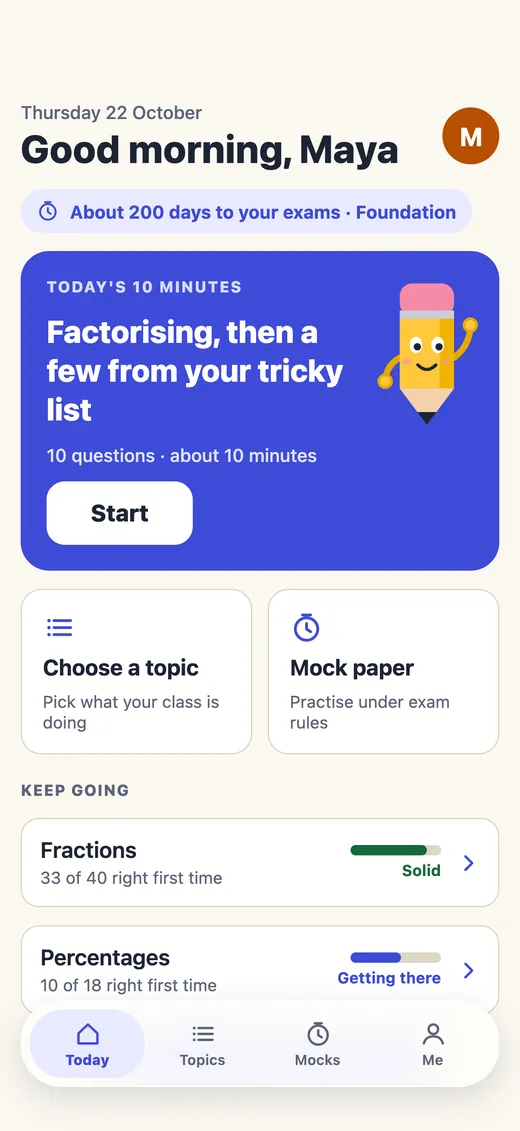
Today in Show Working: a short daily set and the topics worth a look

Show WorkingFree on the App StoreFree in your browser, no download

Open it free