

Show Working
Open the app

Exam-style problemsFoundation and Higher (some Higher only)

Multi-step problems GCSE questions with answers

8 multi-step problems questions to try, each with the answer and the full working one tap away. Every question here was made and worked out by the Show Working maths engine, not typed in by hand.

Most marks on a GCSE maths paper come from questions worth 3, 4 or 5 marks that join several steps together: a perimeter that leads to an equation, paint for a wall, a bill with VAT, two picks from a bag. You find the key values one by one, then give one final answer. Each step that is right earns a method mark, even if the final answer goes wrong.

Quiz yourself: 8 questions

Worked example 1: best buy, and by how much

A shop sells batteries in two packs.
Pack A: 4 batteries for £1.68
Pack B: 12 batteries for £4.32
Which pack is better value? Work out how much less one battery costs in the better pack. Give your answer in pence.

  1. Pack A: 168 ÷ 4 = 42, so one battery costs 42p.
  2. Pack B: 432 ÷ 12 = 36, so one battery costs 36p.
  3. Pack B is better value, because each battery costs less. The difference is 42 − 36 = 6p.

Answer 6p
01 / Quiz yourselfTry it, then tap to check

Multi-step problems questions to try

Work each one out on paper first. Then open the answer and compare your working with ours, step by step.

01 / Best buy, and by how muchBoth tiers

A shop sells batteries in two packs.
Pack A: 5 batteries for £4.35
Pack B: 12 batteries for £10.92
Which pack is better value? Work out how much less one battery costs in the better pack. Give your answer in pence.

Show the answer and working
  1. Pack A: 435 ÷ 5 = 87, so one battery costs 87p.
  2. Pack B: 1092 ÷ 12 = 91, so one battery costs 91p.
  3. Pack A is better value, because each battery costs less. The difference is 91 − 87 = 4p.

Answer 4p

02 / Area from the perimeterBoth tiers

A rectangle is (2x + 7) cm long and (x + 1) cm wide.
Its perimeter is 70 cm.
Work out the area of the rectangle.

Show the answer and working
  1. The perimeter is twice the length plus twice the width: 2(2x + 7) + 2(x + 1) = 70.
  2. Halve both sides: 2x + 7 + x + 1 = 35, so 3x + 8 = 35.
  3. Take 8 from both sides: 3x = 27. Divide by 3: x = 9.
  4. Put x = 9 back in: the length is 2 × 9 + 7 = 25 cm and the width is 9 + 1 = 10 cm.
  5. Area = length × width = 25 × 10 = 250 cm².

Answer 250 cm²

03 / How much paint, and the costBoth tiers

Dev is painting a wall that is 9 m wide and 2.4 m high.
The wall has a door in it that is 2 m high and 0.8 m wide. The door is not painted.
The wall needs two coats of paint. One litre of paint covers 12 m².
Paint is sold in 2.5 litre tins that cost £14.50 each.
Work out how much Dev spends on paint.

Show the answer and working
  1. Area of the wall: 9 × 2.4 = 21.6 m². Take away the door, 2 × 0.8 = 1.6 m²: 21.6 − 1.6 = 20 m².
  2. Two coats means painting 2 × 20 = 40 m².
  3. Litres needed: 40 ÷ 12 = about 3.33 litres.
  4. Each tin holds 2.5 litres, so 3.33 ÷ 2.5 is about 1.33 tins. You cannot buy part of a tin, so round up to 2 tins.
  5. Cost: 2 × 14.50 = £29.00.

Answer £29.00

04 / Share, then spend a percentageBoth tiers

Chloe and Dev share £225 in the ratio 7 : 2.
10% of Dev's share is spent on trainers.
How much money does Dev have left?

Show the answer and working
  1. There are 7 + 2 = 9 parts. One part is 225 ÷ 9 = 25, so £25.
  2. Dev gets 2 parts: 2 × 25 = 50, so £50.
  3. 10% of £50 is 50 × 10 ÷ 100 = £5.00.
  4. Left: 50 − 5 = £45.00.

Answer £45.00

05 / Angles in a triangle with algebraBoth tiers

The angles of a triangle are (x + 32)°, (2x + 17)° and (3x − 13)°.
Work out the size of the largest angle.

Show the answer and working
  1. Angles in a triangle add up to 180°: (x + 32) + (2x + 17) + (3x − 13) = 180.
  2. Collect like terms: 6x + 36 = 180.
  3. 6x = 144, so x = 24.
  4. The angles are 24 + 32 = 56°, 2 × 24 + 17 = 65° and 3 × 24 − 13 = 59°. They add up to 180°, which checks the answer.
  5. The largest angle is 65°.

Answer 65°

06 / Carpet for an L-shaped roomBoth tiers

The diagram shows the floor of a room. All the corners are right angles.
Carpet costs £18 per m².
Work out the cost of carpet for the whole floor.

4 m3 m7 m6 m
Not drawn accurately
Show the answer and working
  1. Find the missing lengths. The cut-out corner is 7 − 4 = 3 m wide and 6 − 3 = 3 m deep.
  2. Think of the floor as a 7 m by 6 m rectangle with that corner taken away: 7 × 6 − 3 × 3 = 42 − 9 = 33 m².
  3. Cost: 33 × 18 = 594, so £594.

Answer £594

07 / Leaving together again: the timeBoth tiers

Two trams leave a tram stop in the city centre together at 12:35 pm.
The red line tram leaves every 15 minutes.
The blue line tram leaves every 10 minutes.
At what time will the two trams next leave together?

Show the answer and working
  1. Multiples of 10: 10, 20, 30.
  2. Multiples of 15: 15, 30.
  3. The first number in both lists is 30, the lowest common multiple (LCM). So they next leave together 30 minutes later.
  4. 30 minutes after 12:35 pm is 1:05 pm.

Answer 1:05 pm

08 / Packs of two sizes: the fewest to buyBoth tiers

Isla is buying candles and candle holders for a party.
Candles come in packs of 6. Candle holders come in packs of 4.
Isla wants to buy exactly the same number of candles as holders.
What is the smallest number of packs of each that Isla can buy?

Show the answer and working
  1. Multiples of 6: 6, 12.
  2. Multiples of 4: 4, 8, 12.
  3. The first number in both lists is 12, the lowest common multiple (LCM). So Isla needs 12 candles and 12 holders.
  4. Packs of candles: 12 ÷ 6 = 2. Packs of holders: 12 ÷ 4 = 3.

Answer 2, 3

02 / What's covered52 kinds of question

Multi-step problems at GCSE and where marks go

  • Best buy, and by how muchBoth tiers
  • Area from the perimeterBoth tiers
  • How much paint, and the costBoth tiers
  • Share, then spend a percentageBoth tiers
  • Angles in a triangle with algebraBoth tiers
  • Carpet for an L-shaped roomBoth tiers
  • Leaving together again: the timeBoth tiers
  • Packs of two sizes: the fewest to buyBoth tiers
  • Pay with overtimeBoth tiers
  • The largest squares, the most bagsBoth tiers
  • Ages from a totalBoth tiers
  • Angles in algebra: the largest angleBoth tiers
  • The nth term, then which termBoth tiers
  • A line through two points: where it crosses the x-axisBoth tiers
  • Solve an inequality, list the whole numbersBoth tiers
  • Ratio: from the difference to the totalBoth tiers
  • Cheaper at home or abroad?Both tiers
  • Recipes: the most you can makeBoth tiers
  • More workers to finish soonerBoth tiers
  • Pythagoras, then the perimeterBoth tiers
  • How long to fill the tank?Both tiers
  • Rectangle and part of a circleBoth tiers
  • How many sides has the polygon?Both tiers
  • Perimeter of a sectorBoth tiers
  • Missing probabilities, then expected resultsBoth tiers
  • A Venn diagram from words, then a probabilityBoth tiers
  • Complete a two-way table, then a probabilityBoth tiers
  • Relative frequency, then an estimateBoth tiers
  • Working back from the meanBoth tiers
  • The mean of two groups togetherBoth tiers
  • A pie chart with a missing angleBoth tiers
  • Two picks, the same colourBoth tiers
  • Average speed for a whole journeyBoth tiers
  • A rise, then a fall: the overall changeBoth tiers
  • Prices from two shopping listsBoth tiers
  • A fraction, then a fraction of the restBoth tiers
  • An electricity bill with VATBoth tiers
  • Standard form in real lifeBoth tiers
  • A perpendicular line through a pointHigher only
  • Adult and child ticketsBoth tiers
  • Simple or compound interest: which pays more?Both tiers
  • Mark-up, then a sale: profit or lossBoth tiers
  • The price before the change: which shop was cheaper?Both tiers
  • How steep is the ladder?Both tiers
  • Paving a path round a lawnBoth tiers
  • Two independent events: at least one, or exactly oneBoth tiers
  • Estimate the mean from grouped dataBoth tiers
  • Two picks without replacement: different, or at least oneBoth tiers
  • A quadratic from an areaHigher only
  • A ratio that changesHigher only
  • Cosine rule, then perimeter or areaHigher only
  • Similar containers: the volumeHigher only

Worked example 2: similar containers: the volume

Two candles, A and B, are mathematically similar.
The volume of A is 2,416 cm³ and the volume of B is 8,154 cm³.
The height of A is 20 cm. Work out the height of B.

AB20 cm
Not drawn accurately
  1. Volume scale factor from A to B: 8154 ÷ 2416 = 278.
  2. Lengths scale by the cube root of that. The cube root of 278 is 32, because (32)3 = 278.
  3. Height of B = 20 × 32 = 30 cm.

Answer 30 cm

A common mistake

Stopping one step early. If the question asks how much the paint costs, the number of tins is not the answer: multiply by the price. Read the last line of the question again before you write your answer.

03 / Practise itiPhone and iPad

More multi-step problems questions in Show Working

In the app, Multi-step problems makes fresh questions every time, so they never run out. Tap Show me one to see a new worked example straight away, or practise ten and open the working whenever you are stuck. Forgotten a method? Type it into Look up and the answer is there.

More exam-style problems topics

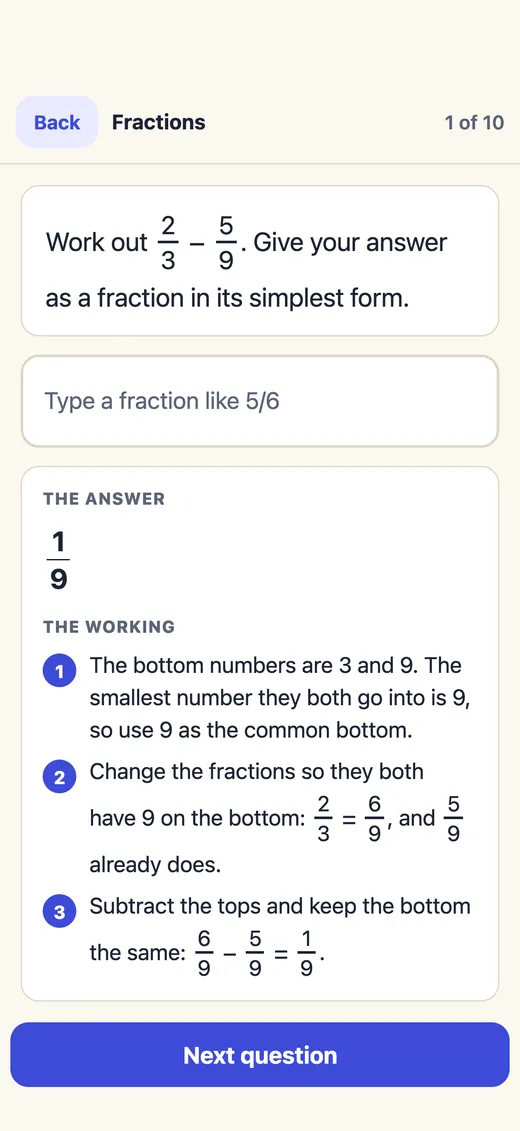
The worked answer in Show Working: the answer, then numbered steps in plain words

Show WorkingFree on the App StoreFree in your browser, no download

Open it free